“Death is the road to awe.”
Some four thousand years ago, in the river cities of Mesopotamia, people told a story about a king who could not accept that his friend was dead. When Enkidu died, Gilgamesh of Uruk refused to give him up for burial until a maggot fell from his nostril. Then, terrified of his own death, he walked to the edge of the world to find Uta-napishti, the one man the gods had spared. The old man told him what elders have always told the young: the gods fixed death for us, and kept its day hidden. Then, as a parting gift, he revealed a secret. A thorny plant grows at the bottom of the deep, and it makes the old young again. Gilgamesh tied stones to his feet, sank down and tore it loose. On the way home he stopped to bathe in a cool pool. A snake smelled the plant, slid out of the water and carried it off, shedding its skin as it went. Gilgamesh sat down and wept (the epic’s eleventh tablet).
It is one of the oldest stories ever written down, and it is about refusing to die. We have been telling it ever since: in the tree God kept from Adam and Eve, in the elixirs of the alchemists, in the Fountain of Youth a Spanish explorer was said to have sought in Florida. Darren Aronofsky’s The Fountain (2006) tells it three times at once. Then it does something the old stories rarely dare. It suggests the snake understood something the king did not.
The Plot
At first glance, The Fountain seems to tell three distinct stories: one in 16th-century Spain, one in the present day, and one in a far future that feels like a vision. Underneath those timelines runs a single consciousness that is searching, resisting, and finally surrendering to a truth that Izzi states in story form. Death is not the enemy of life. It is the mechanism through which life continues.
Before any of them begins, the film puts a line of scripture on the screen: a paraphrase of Genesis 3:24, in which God drives Adam and Eve out of Eden and sets a flaming sword to guard the tree of life. Keep an eye on that sword. It comes back.
Present day — Tom and Izzi
Dr. Tom Creo (Hugh Jackman) is a neurosurgeon racing to cure brain tumors. His wife, Izzi Creo (Rachel Weisz), is dying from one. Tom believes love can be preserved if death can be defeated, so he spends his nights in the lab, testing an extract from a tree found in Guatemala on a monkey named Donovan. When Izzi comes by the lab in a white knit cap and asks him to walk with her in the first snow, he tells her he has too much work. After the surgery that follows, his wedding ring is missing. His boss, Dr. Lillian Guzetti (Ellen Burstyn), calls him reckless and tells him to go home to his wife. He is steady in the lab and absent at home. The irony is sharp. His breakthroughs arrive only after he has missed the moments that mattered.
Izzi spends her final weeks writing a novel called The Fountain. She has accepted her mortality. Her acceptance is not resignation. It is understanding. She wants Tom to see what she sees: that endings are part of a larger movement of matter and energy, what Aronofsky himself has called “this endless cycle of energy and matter” (in interview). One evening in the bath she asks Tom to warm the sponge, and he realizes she can no longer feel heat or cold. She tells him she feels different inside, every moment. For one scene, Tom stops resisting time and lives inside it.
At a museum exhibit on the Maya, Izzi tells Tom the story of First Father, who sacrificed himself to make the world. The tree of life grew from his body, she says. His body became its roots and his soul its branches, and his children hung his head in the sky, where it became Xibalba, the glowing nebula of the film’s heavens. Then she asks Tom what he thinks of death as an act of creation, an idea Aronofsky has called one of the film’s major lines (in interview).
In the hospital, Izzi gives Tom a pen and a bottle of ink. The book is finished except for the last chapter, she tells him, and he will write it. Then she tells him about Moses Morales, a Maya guide she met on her travels. When his father died, a seed was planted over the grave. The tree that grew took the father into its wood and its blossoms, and when a sparrow ate its fruit, the father flew off with the birds. Morales called his father’s death a road to awe. Izzi tells Tom she isn’t afraid anymore. Weisz plays the whole speech in one extreme close-up, about forty seconds long. Aronofsky first cut it together from pieces of several takes, then went back and found a single unbroken take that held (in interview). The name may be a tribute: a doctoral study of the film connects the character to Moisés Morales, the first guide at the Maya city of Palenque and host of the first Palenque Round Tables, where much of modern Maya scholarship took shape (dissertation, interview).
Izzi dies. At the funeral Lillian says that we all struggle to become whole and that few of us reach grace, but that Izzi, young as she was, got there. Outside, Tom whispers that death is a disease like any other, that there is a cure, and that he will find it. Afterward, he tattoos a ring onto the finger where his wedding band used to be.
The past — Tomás and Queen Isabel
Inside Izzi’s book, Spain is in the grip of the Inquisition. Tomás (also Jackman), a conquistador, serves Queen Isabel (also Weisz), who sends him to New Spain to find the Tree of Life. Before he leaves, she gives him a ring and makes him a promise: when he returns, she will be his Eve, and together they will live forever.
At the top of a Maya pyramid, Tomás meets the tree’s guardian, a priest with a flaming sword. It is the sword from the film’s first frame. The priest tells him that First Father gave his life for the tree, stabs him, and raises the burning blade as he tells him that death is the road to awe. Izzi’s last written line reads, “And all he could see was death.” She dies before finishing the chapter, and leaves it to Tom. What happens next at the top of the pyramid belongs to the ending, and to the traveler.
The future — the traveler and the tree
A bald traveler (Jackman again) drifts through space in a transparent sphere with a dying tree. He meditates, eats strips of the tree’s bark, and talks to it as if to Izzi. His arms are tattooed with rings that count the years of his voyage. He is sailing toward Xibalba, the nebula from Izzi’s story, hoping that its death will bring the tree back to life. Aronofsky has said Tom’s name probably came from David Bowie’s “Space Oddity,” whose astronaut, Major Tom, ends the song drifting alone in space (in interview).
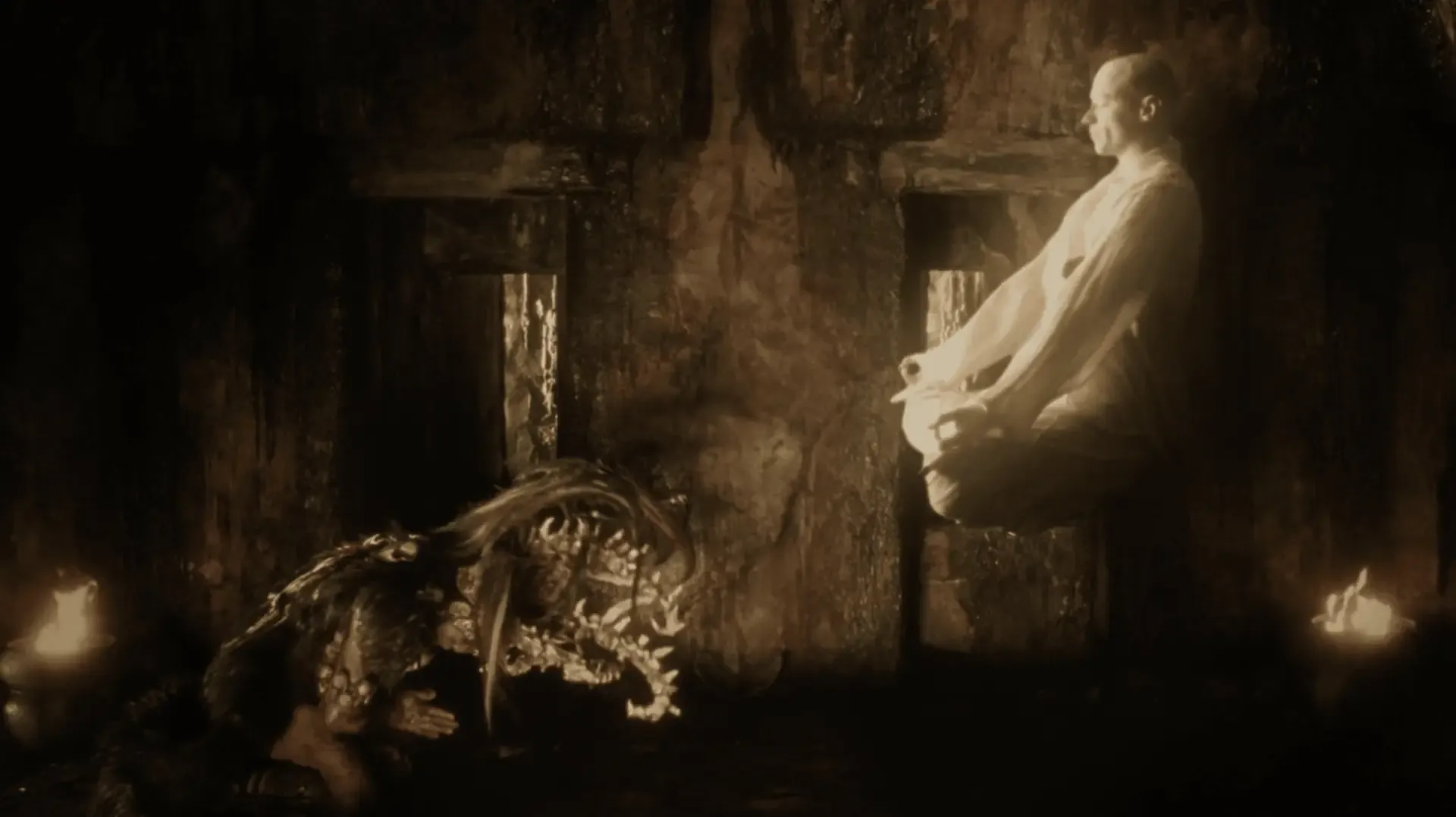
Near the star, his tree dead, the traveler hears Izzi’s voice telling him to finish it. He admits he is afraid. Then he says, twice, that he is going to die, and smiles. He rises toward the light, and the three stories meet at the top of the pyramid in Izzi’s book, where the priest kneels to the traveler as First Father and Tomás finally reaches the tree and drinks. The star explodes, the tree blooms, and the traveler dissolves into light. In the still at the top of this page the three stories touch: the traveler floats in a gold glow above the kneeling priest, the future appearing to the past.
Back in the present, the film replays the moment Tom turned Izzi down, and this time he goes. In the last scene, Tom finishes the book. Then he kneels at Izzi’s grave in the snow and plants a seed.
The Fountain’s Structure and Purpose
The timelines are not puzzles to solve. They are variations on one lesson. Aronofsky structures the film like a circle of motifs (ring, tree, water, star) that recur, evolve, and return changed. The conquistador’s quest is mythic. The surgeon’s struggle is scientific. The traveler’s journey is cosmic. All three are expressions of the same mistake that love must correct.
Aronofsky has described the three men as three parts of the same person (production notes) and compared the structure to a set of Russian nesting dolls (in interview). Izzi tells Tom that her book begins in Spain and ends at Xibalba. Read that way, the conquistador is her story, the traveler is Tom’s attempt to write her last chapter, and the present day is where the two of them actually live. Aronofsky has allowed that reading while declining to make it the only one (in interview). The film is built so you can hold all three at once.
He gave each era its own shape (in interview). The 16th century is built from triangles: pyramids, Spanish towers, the three stars of Orion. The present is built from squares: screens, doors, windows, the grid of the lab. The future is built from circles: planets, orbits, the sphere the traveler lives in, and the biggest circle of all, the rings he tattoos around his arm, one after another, as the years pass. Once you see it, it is everywhere. The argument is in the geometry. A triangle points somewhere. A square encloses. A circle returns.
The film that almost died
The first version of The Fountain was a $70 million epic starring Brad Pitt and Cate Blanchett (in interview). In 2002 it collapsed about seven weeks before shooting (in interview), with sets, including a 120-foot Maya pyramid, already going up in Australia (in interview). Aronofsky rebuilt it two years later for about half the money, with Jackman and Weisz. He had begun the project after both of his parents were diagnosed with cancer, weeks apart, the year he turned 30 (profile). It is hard not to hear the film’s argument in its own history: a story that had to die in one form to live in another.
A universe in a petri dish
Aronofsky didn’t want his cosmos built in a computer. Digital effects date within a year, he argued, while real particles moving through real space don’t. So the nebulae and star fields were filmed by Peter Parks, a cofounder of the nature-film company Oxford Scientific Films, who spent a month shooting chemical reactions in petri dishes through a microscope, using, among other things, yeast and curry powder. The effects house Intelligent Creatures built 234 shots from his footage; a few moments, like the exploding star, were made by computer (effects report). The result is a lovely trick. The nebula at the end of the film is chemistry a few millimeters across, filmed so closely that it reads as light-years. For a film arguing that the smallest things and the largest are made of the same stuff, it is exactly right.
Clint Mansell’s score, played by the Kronos Quartet and the Scottish band Mogwai, was nominated for a Golden Globe (Nonesuch). The film drew boos at Venice, then standing ovations (profile), and earned back less than half its budget in theaters (box office).
The Tree of Life — myth and religion
Almost every culture has planted a tree at the center of its world. The Fountain plants several, and it knows which gardens they came from.
The tree behind the sword
Genesis describes two trees in the middle of Eden: “the tree of life also in the midst of the garden, and the tree of knowledge of good and evil” (Genesis 2:9, King James Version). After Adam and Eve eat from the second, God worries aloud about the first: “lest he put forth his hand, and take also of the tree of life, and eat, and live for ever.” So he drives them out, and he places at the east of the garden “Cherubims, and a flaming sword which turned every way, to keep the way of the tree of life” (Genesis 3:22–24). The film’s opening card keeps the sword and leaves out the cherubim.
Read plainly, the story makes mortality the price of knowing. Humans can have the knowledge of good and evil, or they can have endless life. They cannot have both. Aronofsky reads it the same way.
“What makes us human is actually Death. It makes us special.”Darren Aronofsky, ScreenAnarchy roundtable, 2006
Tomás’s quest is an attempt to walk back past the sword, and Isabel’s promise to be his Eve makes the ambition plain: to undo the Fall, and eat from the tree they were kept from. The film puts the flaming sword in a priest’s hand at the top of a pyramid, exactly where Genesis said it would be, standing in the way of the tree. What waits behind it is not a reward. It is the thing Genesis was protecting us from: life that cannot end, and therefore cannot change.
First Father and the Road of Awe
The Maya pictured the cosmos in layers, the sky, the middle world of people, and Xibalba below, joined by a great World Tree that is often a ceiba (Smithsonian). Their most famous book, the K’iche’ Maya Popol Vuh, tells how the lords of Xibalba killed the hero One Hunahpu and set his head in a barren tree beside the road, which promptly bore calabash gourds. When a young woman named Lady Blood stretched out her hand toward the fruit, the skull spat into it and told her that a father lives on in his children. She conceived the Hero Twins, who went down into Xibalba, outwitted the lords of death, and rose into the sky as the sun and the moon (Popol Vuh).
In older Maya art the maize god dies and sprouts again like corn, rising from a split turtle shell that stands for the earth (the Met, plate). The epigrapher Linda Schele nicknamed him First Father, which is where Izzi’s story gets its name. On the sarcophagus lid of K’inich Janaab Pakal, the great king of Palenque, the World Tree rises above Pakal as he passes through the jaws of the underworld. Scholars once read the scene as his fall into death; they now read it as death and rebirth fused into a single moment (epigraphy). Aronofsky had studied that carving for months, maybe years, but he has said he didn’t see what it had done to his film until the image reached the poster. The traveler’s last pose, thrown backward as his star explodes, is Pakal’s pose on the lid (roundtable).
One detail would have pleased Izzi. Among the Tz’utujil Maya of Santiago Atitlán, a tree may be planted on a grave to stand for the soul reborn (Popol Vuh, note 271). Moses Morales’s story is more than a metaphor. It is a custom.
Izzi’s version, in which First Father’s own body becomes the roots of the world and his soul its branches, is not in the Maya sources; Aronofsky called the film’s mythology a Western take on them. It is closer to a family of creation myths scattered across the globe, in which a sacrificed body becomes the cosmos. In the Rig Veda, the gods sacrifice the cosmic man Purusha and make the sun, the sky and the earth from his body (Britannica). In Norse myth, the gods build the land from the giant Ymir’s flesh and the sea from his blood (World History). In China, the dying Pangu becomes the mountains and rivers (EBSCO). Joseph Campbell spent a lifetime pointing at patterns like these. His argument in The Hero with a Thousand Faces (1949) was that the world’s myths keep telling one story in many costumes (Joseph Campbell Foundation). The Fountain proves his point almost by accident: reaching for one culture’s myth, it lands on the shape they share.
The film’s most quoted line may come from a scholar’s notebook. The Maya saw the road to Xibalba in the night sky, in the dark rift that splits the Milky Way, and in Maya Cosmos (1993) Schele and her coauthors glossed its name, Xibal Be, as the Road of Awe (Schele and Villela, dissertation). A phrase from a work of Maya scholarship became the line the whole film turns on.
The film takes other liberties, and they are worth knowing. The flowers that burst from Tomás echo a belief recorded among the Aztecs rather than the Maya: that warriors who fell in battle came back as hummingbirds and butterflies, feeding among the flowers (Florentine Codex). And Aronofsky placed Xibalba in the Orion Nebula, which, as we’ll see, is a stranger and better choice than he may have known.
Trees at the center of the world
Campbell called the place where such trees grow the World Navel: the center of the world, where heaven, earth and the underworld meet and eternity breaks into time. In his telling, the Tree of Life grows there with a spring bubbling at its foot. A fountain at the root of the tree. It is hard to imagine a more exact gloss on Aronofsky’s title.
The Norse world tree, Yggdrasil, holds nine worlds in its branches and roots. Odin hangs himself on it for nine nights, pierced by a spear, an offering, as the Poetic Edda has him say, “myself to myself,” and on the ninth night he looks down and seizes the runes (Hávamál). Siddhartha Gautama sits beneath a fig tree at Bodh Gaya and vows not to rise until he finds what lies beyond birth and death. Mara, the lord of desire and death, sends storms and armies, but the weapons turn to flowers; the future Buddha touches the earth as his witness, and wakes up (Britannica). Medieval Christians called the Cross itself the Tree of Life. Bonaventure’s meditation Lignum vitae (around 1260) pictures Christ as a tree bearing twelve fruits, and ends by sending the reader to Christ as the fountain of life (Stanford Encyclopedia, Yale). A medieval legend goes further: Adam’s son Seth plants a branch of Eden’s tree on his father’s grave, and its wood becomes the Cross (The Golden Legend). Jewish mystics drew a Tree of Life of their own. In Kabbalah it is a diagram of the sefirot, the ten emanations through which the infinite God flows into the world (sefirot). The tree in the traveler’s sphere began there: its design was modeled on the sefirot, then shrunk from the two or three hundred feet the tree of legend stands to something a camera could hold (production history).
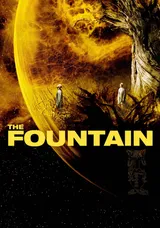
Look again at the still at the top of this page. Aronofsky has listed Buddhist imagery of transcendence beneath a tree among the film’s sources, alongside Genesis and Maya religion (roundtable). The traveler floats in full lotus beside his tree. Jackman spent about a year learning to hold the pose and played many of those scenes underwater, on a rotating rig (in interview). A sacrifice on a tree, an awakening beneath one, a branch planted on a grave, a fruit that undoes death, a diagram of God: the film doesn’t choose among the world’s trees. It grows all of them.
The elixir and the Fountain of Youth
Campbell’s map of the hero’s journey has three stages. The hero leaves the everyday world, passes through trials in a region of wonder, and comes home with the power to bestow gifts on others (Joseph Campbell Foundation). The prize at the center he called the ultimate boon, and very often it is the elixir of immortality, which the gods guard as their own. Campbell retells Gilgamesh as a textbook case, snake and all. Then he makes his central claim: searching for physical immortality misreads the myths. What they teach is that the imperishable is already here, once the ego stops blocking the view.
Even Campbell fell for one of the stories. He repeats, as history, the tale that Juan Ponce de León searched Florida for a Fountain of Youth. No document from Ponce de León’s lifetime mentions a fountain. The chronicler Gonzalo Fernández de Oviedo attached the legend to him in 1535, years after his death and apparently to mock him, and later writers turned the joke into accepted history (Smithsonian). The conquistador of The Fountain inherits that legend, and so does his queen. The real Isabella of Castile backed Columbus’s voyage in 1492 and, with Ferdinand, won the pope’s permission in 1478 to set up the Spanish Inquisition (Britannica). The film’s Isabel, threatened by a Grand Inquisitor in her own court, is a dream of her: a queen sending a soldier to fetch eternity.
Themes, Symbolism, and Philosophical Meaning
Three stories, one man — the cuts that rhyme
The Fountain doesn’t tell its stories one after another. It braids them. “Every element of every timeline is in every other timeline,” Aronofsky said, and he called the result a fractal picture, with nearly every echo planned before the cameras rolled (in interview). The film cuts from one century to the next on a matching shape, gesture or sound, so the eye feels the connection before the mind can name it. Played by one actor and cut as one body, the three men become a single person moving through time.
Start with the camera. A conquistador rides through a night forest, a surgeon drives down a road, a sphere sails toward a star, and each shot does the same strange thing. It begins upside down as the rider comes toward us and rolls right side up as he passes. Aronofsky called them the woosh shots, the horse going by, the car going by and the ship going by, and said all three were planned from the start (in interview). Three vehicles, three centuries, one journey.
The tenderest rhyme is a touch. In the present, Tom kisses the nape of Izzi’s neck, and the fine hairs there rise to meet him. In the sphere, the traveler brings his lips and fingers close to the tree, and the fine hairs on its bark rise the same way. Aronofsky has said the hairs were how they brought the tree alive, and that they tie straight back to Izzi (roundtable). The tree in the sphere has her skin. Whatever else it is, it is her.
Then watch what each man does to the tree. Tomás stabs the trunk with a Maya dagger, rubs the white sap into his wound and drinks. Tom tests an extract of a Guatemalan tree on a dying monkey and operates on the animal’s brain. The traveler takes a little bark and eats it, to keep himself alive. Three centuries, one gesture: each man cuts into something living to take its life for himself. The mistake isn’t Spanish, or modern, or futuristic. It is human, and the film makes us watch it three times.
The bodies rhyme too. Tomás kneels when his queen commands it. The priest kneels when he sees First Father. Tom kneels in the snow at Izzi’s grave. Each of them bows to something. The conquistador bows to a queen who promises him forever. The other two bow to death.
Even the words come back. In the hospital, Izzi asks Tom to finish her book. In the sphere her voice keeps whispering the same two words to the traveler, finish it, until near the end he answers: okay. The music works the same way. Clint Mansell gave up on a separate sound for each century and kept the whole score playable as piano themes, so that any piece could be woven into any other (in interview). By the climax, themes that have taken turns all film sound at once (dissertation).
The rhyme that matters most is a refusal. Early on, Izzi comes to the lab in a white knit cap and asks Tom to walk with her in the first snow. He has too much work. Rachel Weisz has called that moment the emotional core of the film, the kind of choice people regret at the end of their lives (in interview). Remember it. The ending turns on it.
Rings — the form of eternity
In this film a ring does not brag about permanence. It names continuity through change. Tom loses his gold wedding ring soon after he brushes off Izzi’s invitation to take a simple walk in the snow. The lost metal matches a lost meaning. The ring was never a promise of duration. It was a promise of presence.
Follow the ring through all three stories. In Spain, Isabel gives Tomás a ring to wear when he finds Eden, and a promise of forever. After Izzi dies, Tom tattoos a ring where his wedding band should be, using the pen and ink she gave him to finish her book. The tool meant for her last chapter becomes the needle for his grief. The ink binds remorse to skin. In the future, the traveler is still at it, tattooing ring after ring onto his forearms until they look like the growth rings of a tree. They mark time passed and lessons delayed.
The ring is also the film’s master shape. The future belongs to circles, and the last act is all orbits: the sphere, the planets, the nebula, the rings on the traveler’s arms. Analytically, the ring corrects a definition. Eternity here is not life without end. Eternity is the unbroken continuity that requires endings to continue.
It is one of the oldest pictures of eternity we have. On a gilded shrine from Tutankhamun’s tomb, a snake circles with its tail in its mouth. The Greeks called the figure the ouroboros, the tail-eater, and alchemists later drew it around the words “the all is one” (ouroboros). It is Gilgamesh’s snake again, this time swallowing its own tail: an ending fastened to a beginning, a death that feeds a life.
The Song of Songs has a line for the rings on the traveler’s arms. “Set me as a seal upon thine heart, as a seal upon thine arm,” the lover asks, “for love is strong as death” (Song of Solomon 8:6, King James Version). The traveler wears his love exactly where the poem asks for it. And the verse names the contest the whole film stages, love against death, and calls it even. The Fountain spends its last act showing why. They were never opponents.
Xibalba — the star of death and rebirth
In Maya thought Xibalba is the underworld, a place of trials the dead must pass through. Aronofsky turns that geography into a star about to explode. The traveler spends a lifetime fearing it because it mirrors Izzi’s death. As he nears the star he sees the invitation inside the threat. At its edge he accepts that he is going to die, and there is peace in it. The sphere breaks, the tree ignites, and seeds scatter into space. Death reads not as erasure but as production. The star’s collapse becomes another kind of creation.
Here the film is more literal than it looks. Nearly every atom in your body heavier than hydrogen was made inside a star. Stars spend their lives fusing light elements into heavier ones, carbon, oxygen and nitrogen on up to iron, and the most massive stars end in supernovae that scatter those elements across space, where they become part of new stars, new planets and, eventually, new living things (NASA). The iron carrying oxygen through your blood right now was forged in stars that died before the sun was born. Carl Sagan put it in a single word: we are made of starstuff (Cosmos). When the traveler’s star explodes and his tree blooms, the film is telling, in the language of myth, a story astronomers can measure.
There is one more twist. Aronofsky placed Xibalba in the Orion Nebula, believing that was where the Maya located it (roundtable). Scholars read the Maya sky differently: three stars in Orion were the hearthstones of creation, and the nebula glowing among them was the fire in the hearth (Schele and Villela). And astronomers know the Orion Nebula as a nursery, a cloud where new stars are being born right now (NASA). The film calls Xibalba a dying star. The patch of sky it chose is a cradle. Both are true of the same cycle, which is the film’s whole point.
Light and darkness — the movement of understanding
Light in this film is a language. Aronofsky built The Fountain from three colors, black, white and gold, and describes it as a movement from darkness into light (in interview). Tom’s lab is flooded with cold fluorescents. It is intellect without presence. Scenes with Izzi glow warm and alive. That was planned ten months before the shoot: Jackman’s characters are kept in the dark and Weisz’s in the light (in interview). In each era he starts in silhouette, and the light on him grows as his story moves toward her (American Cinematographer, via Wikipedia).
Even the blur means something. Candles in the queen’s chamber and Christmas lights on a rooftop were shot out of focus so they would echo the star fields of the future (in interview).
The colors carry a verdict as well. The filmmakers told American Cinematographer that gold belongs to the Maya and is a kind of fool’s gold, a false truth, while white stands for mortality, and for truth (via Wikipedia). In the future, the bubble is washed in soft white. Light no longer comes from outside. It arrives from within. As Tom accepts, the world brightens. At the end he is almost indistinguishable from the light that receives him. The film does not end in gold. It ends in white.
Water — the flow of connection
Water is the quiet thread that turns theme into experience. The bath is the clearest example. Izzi invites Tom to feel the moment completely. The room softens. It is baptism without doctrine. The title names a circulation: a fountain lifts water up and lets it fall, and the falling feeds the rising. Later, snow falls on Izzi’s grave. Frozen water waits to move again. The film ends in a storm of light and particles that echoes the same cycle.
Duality — life and death as one motion
Everything here is a negotiation between pairs that look opposed. Light and dark. Past and future. Body and spirit. Love and loss. The lesson is not to choose. It is to see through the division. Tom experiences them as enemies. Izzi experiences them as one. The final images (the tree on fire, the star in bloom, the seed in the snow) fold the pairs into a single motion.
The ending — two men, one ring
In the last act the three stories stop taking turns. The traveler, his tree dead, hears Izzi’s voice asking him to finish it. He admits he is afraid. Then he says it, twice: he is going to die. And he smiles. It is the sentence Tom could not say at the funeral, and one Tomás would never say at all.
Then the stories meet. The traveler rises toward the light and appears at the top of the pyramid in Izzi’s book, glowing, in lotus. The priest who guarded the tree for First Father sees First Father at last. He lowers the flaming sword, kneels, and gives up his life, which Tomás takes. Two versions of one man now stand at one tree, and the film lets us watch them make opposite choices.
Tomás reaches the tree, and its sap closes his wound. He has carried Isabel’s ring across an ocean, to be worn when he found Eden. He has found it. “My queen,” he says, “now and forever,” and he begins the old promise that they will be together, and never finishes the word. He brings the ring toward his finger, and pain stops him before it goes on. Shoots split his skin. Flowers pour out of him and bury him. When the ring appears again, it is lying on the ground. He gets exactly what he asked for. He will live forever, as a garden.
The traveler picks up the ring and slides it onto his finger, over the black band tattooed there. The mark Tom made in grief and the token of Isabel’s promise end up on the same finger. A moment later the star explodes, his body is thrown backward into Pakal’s pose, and the tree blooms.
Those two images are the film’s argument, made without a word. The ring never goes on the man who is searching for life. It goes on the man who has understood death.
The marriage service in the Book of Common Prayer binds a couple “till death us do part” (1662). The traveler’s vow runs the other way. His ring goes on at the moment of death, as if death were the wedding rather than the end of one. Sufism has a word for exactly that. ʿUrs, Arabic for wedding, is what Sufis call a saint’s death day, because death is the soul’s union with God, the Beloved (Oxford Dictionary of Islam). Rumi died in Konya on December 17, 1273, and his followers still keep the date as his wedding night (Dar al-Masnavi). The Fountain arrives at the same image without the theology. The ring is the wedding, and the wedding is the death.
And the third man? Back in the present, the film replays the moment in the lab. Donovan is open on the table, and Izzi has come by in her white knit cap. This time Tom walks away from the operation and goes after her into the snow. On the walk she offers him a spiky seedpod, like the fruit of a sweetgum tree, and the film cuts from her open palm to the seedpod he plants at her grave.
Three men set out to beat death. The conquistador wins, and becomes a garden. The surgeon gets his breakthrough too late, and plants a seed instead. The traveler loses everything, says out loud that he is going to die, and puts on the ring.
Existential and Analytical Interpretation
The analytical core — a question of definitions
The film begins from a common premise: life is valuable, death ends life, therefore death is the enemy of value. The story proceeds to falsify the argument. Value does not arise from duration. It arises from depth of presence. Izzi’s peace is the counterexample that breaks Tom’s logic. Isabel’s promise that they will live forever sounds like a denial of death. By the end it reads as a redefinition of life.
Nothing to fear — Epicurus and Lucretius
About 2,300 years ago in Athens, Epicurus offered a cure for the fear of death that still works if you let it. Good and bad require sensation, he wrote to his follower Menoeceus, and death is the end of sensation: “Death, therefore, the most awful of evils, is nothing to us, seeing that, when we are, death is not come, and, when death is come, we are not” (Letter to Menoeceus). The fear, he thought, comes from imagining ourselves present at our own absence.
His Roman follower Lucretius, writing two centuries later, added an argument from symmetry. Look back at the eternity before you were born. It never troubled you, and it is the mirror of the eternity to come: “And Nature holds this like a mirror up / Of time-to-be when we are dead and gone.” Lucretius also gave the film its physics two thousand years early. In his atomism nothing comes from nothing, and nothing is destroyed into nothing; nature takes things apart into their atoms and builds new things from them (Stanford Encyclopedia). Life, he wrote, is given to no one to own, only to use: “in fee-simple life is given to none, / But unto all mere usufruct” (On the Nature of Things). Aronofsky said nearly the same thing about the film: “we’re all just borrowing this matter and energy” (in interview).
Tom lives inside the fear Epicurus tried to dissolve. Izzi lives inside the calm he promised.
Being toward death
Tom’s tragedy is not that he fears losing Izzi. It is that he refuses to live with the knowledge. He treats mortality as a problem to solve. Martin Heidegger had a name for the alternative. In Being and Time (1927) he called it being-toward-death. Death, for Heidegger, is each person’s ownmost possibility: no one can die for us, and its arrival is certain even though its hour is not. Most of the time we flee it, talking about death as something that happens to people in general, and losing ourselves in busyness. Facing it squarely is not morbid. It is what lets us take up our lives as our own (Stanford Encyclopedia).
Tom’s lab is that flight in its purest form. Izzi embodies the opposite stance. She does not retreat from her illness. She inhabits it with attention. When she says she feels different inside, every moment, she names a way of seeing that turns time from a line into a fullness. By the time the traveler reaches Xibalba and accepts that he is going to die, he has learned her language.
The denial of death
In 1973 the cultural anthropologist Ernest Becker published The Denial of Death, which won the Pulitzer Prize for general nonfiction the next year (Pulitzer). Becker argued that the fear of death is the mainspring of human activity, and that every society is a “hero system,” a structure for persuading its members that their lives count for something that will outlast them. Later readers gave the strategies he described a handy name: immortality projects. Empires, monuments, works of art, crusades and laboratories all qualify.
The Fountain is a gallery of immortality projects. The conquistador’s crusade, the surgeon’s lab, the traveler’s endless voyage with his dying tree: each is a heroic, exhausting refusal. Becker thought heroism was, at bottom, a response to the terror of death. The film agrees, and then asks a harder question. What does heroism look like once the terror is gone? Its answer is Izzi, writing a book she will not finish, and asking someone she loves to finish it for her.
The ethics of acceptance
Acceptance here is not passivity. It is ethical clarity. Early on, Tom’s love is control. He confuses conquest with care. Izzi’s love is communion. She asks him to finish her book so that he can join its meaning. When he finally writes the last chapter, he understands that love is participation in change, not possession against it.
Eastern inflections — impermanence and non-attachment
Though not a doctrinal film, The Fountain aligns closely with Eastern ideas of impermanence and interdependence, and Aronofsky has named Buddhist imagery and Hindu ideas of reincarnation among his sources (roundtable). Buddhism calls the first of these ideas anicca: nothing that arises lasts. Suffering comes from clinging to what cannot be held, and the cycle of craving and rebirth is called samsara, a word that means wandering. The way out is nirvana, which means, literally, a blowing out, as of a flame (Britannica).
Tom’s mission to cure death is attachment. Izzi’s quiet joy is non-attachment. The traveler’s long wandering is samsara made literal: he keeps a dying tree alive by eating it, and drags it across the heavens rather than let it go. The Bhagavad Gita pictures the world as a great tree with its roots above and its branches below, and tells the seeker to cut it down with the weapon of non-attachment (Gita, chapter 15). Liberation arrives only when the traveler releases himself and the tree into the star. Water reinforces the lesson. Flow is the natural state. Stagnation hurts.
Existential love — together, in finitude
Existential thought often imagines a solitary person facing the void. This film argues for a form of love that meets the void together. Izzi offers Tom communion, not comfort. The matter that was her becomes the matter that is him. What was both becomes the world. The ring names that continuity. The tree performs it. The star reveals it.
The cosmic argument
Seen as a proof, the film is direct.
Premise 1: All living things die.
Premise 2: Matter and energy are conserved.
Conclusion: Death is not destruction but transformation.
Premise 3: Meaning arises from recognizing transformation.
Therefore: To live meaningfully is to participate fully in change.
The second premise has a long pedigree. Ovid summed it up in the Metamorphoses in four Latin words: omnia mutantur, nihil interit, everything changes, nothing perishes (Book XV). In 1789 Antoine Lavoisier showed that a chemical reaction ends with the same amount of matter it began with: nothing is created, he wrote, and there are only changes (Traité élémentaire de chimie). The tidier slogan often credited to him, that nothing is lost and everything is transformed, is a later paraphrase. Physics has since extended the principle to energy, and Einstein folded mass and energy into one (Britannica). The film turns that bookkeeping into a way of living.
Richard Dawkins arrives at the film’s gratitude from the other direction. He opens Unweaving the Rainbow (1998) with a sentence that could stand as the film’s thesis: “We are going to die, and that makes us the lucky ones” (Unweaving the Rainbow). His point is that the people who could have existed, given every possible combination of genes, vastly outnumber the people who ever will. To be born at all, and so to die, is to have won an almost impossible lottery. Dawkins gets there through genetics. Aronofsky gets there through Maya myth. Both end in awe.
Conclusion — the unity of being
The Fountain reconciles science and spirituality without preaching either. It asks a simple question with honest stakes. What does it mean to live fully, knowing we will die? Its answer is simple and demanding. To live is to participate. To love is to let go. To die is to continue.
Remember the snake. In the oldest version of this story, the plant of renewal goes to the creature that sheds its skin, and the king goes home with nothing but the walls of his city. Campbell read the serpent shedding its skin as one of mythology’s oldest images of life throwing off death to be born again (The Power of Myth). Gilgamesh wept because he wanted the renewal for himself. Tom gets the same ending, and the film turns it into a gift. He finishes the book. He kneels at Izzi’s grave in the snow and plants a seed, as Moses Morales’s family did, and as the Tz’utujil Maya do. He doesn’t get the plant. He becomes the gardener. Izzi’s manuscript stopped at a man who could see nothing but death. Tom’s last chapter ends with a seed in the ground.
In the closing images the tree becomes light, the light fills everything, and a seed goes into frozen ground to wait for spring. The fountain overflows. Isabel’s promise comes true after all, just not the way she meant it.
“Together we will live forever.”
