“You know what kind of plan never fails? No plan at all.”
On the night of January 21, 1968, thirty-one North Korean commandos came down out of the mountains north of Seoul with orders to kill South Korea’s president. They got as far as the old city gate called Jahamun, where a police checkpoint stopped them. All but one were killed or captured (Blue House raid).
South Korea answered in concrete. In 1970 the building law began requiring basements in new homes, as shelters in case the North came again (Segye Ilbo, Hankyoreh). The war never came. People did. Hundreds of thousands moved to Seoul every year, far more than the city could house, so the shelters were rented out, first quietly, then legally. A 1975 change let people live in basements, and a 1984 change counted a room as a basement if only half of it was underground, which created the legal semi-basement (Hankook Ilbo). Koreans call it the banjiha, “half underground.” In 2020 about 327,000 households lived in one, most of them in and around Seoul (Hankyoreh).
On August 8, 2022, the heaviest rain in about eighty years fell on Seoul. In a banjiha in the Sillim-dong neighborhood, water pooled at the entrance and trapped the people inside. A woman, her sister and her sister’s thirteen-year-old daughter drowned while neighbors tried to break the windows from the street (Korea Herald, ABC). Two days later the city promised to phase the semi-basements out (Korea Times). Three years on, it had bought fewer than a thousand of more than two hundred thousand (Financial News).
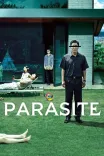
When the news went around the world, it reached for the same shorthand. These were Parasite homes (CNN). Three years before the flood, Bong Joon-ho had shown the world what a banjiha looks like from the inside, and what happens to it in a storm. He filmed part of his poor family’s long run home through the rain on the stairs beside the Jahamun Tunnel, named for the gate where the commandos were stopped (Korea Times). A shelter built for one war became the home of another kind. Parasite (2019) is about that second war, the slow one fought by inequality, and it fights back with architecture.
The Plot
At first glance, Bong Joon-ho’s Parasite is a con-artist comedy. A poor family talks its way, one job at a time, into a rich family’s house. Underneath the comedy runs a map. Every character lives at a height, and the story moves them up and down that map until it breaks. In this city, class is not a ladder. It is a building, and the floors don’t connect.
The semi-basement — the Kims
Kim Ki-taek (Song Kang-ho) lives with his wife Chung-sook (Jang Hye-jin), his son Ki-woo (Choi Woo-shik) and his daughter Ki-jung (Park So-dam) in a banjiha. They fold pizza boxes for cash and hunt for a neighbor’s Wi-Fi. The best signal is by the toilet, which sits on a raised platform. It is the highest point in their home. Production designer Lee Ha-jun lived in a semi-basement as a student, and he has said the set’s bathroom looked exactly like the one he remembered (IndieWire). Ki-taek has been through a string of failed businesses. The last was a Taiwanese castella shop.
Ki-woo’s friend Min-hyuk (Park Seo-joon) arrives with two gifts. One is a scholar’s rock, a landscape stone he says brings a family material fortune. The other is a job: tutoring the teenage daughter of a rich family while Min studies abroad. Ki-jung forges Ki-woo a university certificate. He walks up the hill.
The hill — the Parks
Park Dong-ik (Lee Sun-kyun) runs a tech company. His wife Yeon-gyo (Cho Yeo-jeong) runs the house, which was designed by a famous architect named Namgoong and came with his housekeeper, Moon-gwang (Lee Jung-eun). The Parks have a daughter, Da-hye (Jung Ji-so), and a young son, Da-song (Jung Hyeon-jun), who once saw a ghost come up from the basement and has never been the same.
One by one, the Kims replace the staff. Ki-woo, now “Kevin,” recommends an art therapist named “Jessica,” who is Ki-jung. Ki-jung leaves her underwear in the car to get the driver fired, and Ki-taek takes the wheel. Peach fuzz sets off Moon-gwang’s allergy, Yeon-gyo is persuaded it’s tuberculosis, and Chung-sook becomes the new housekeeper. The family that couldn’t find a Wi-Fi signal now has the run of a house built for looking at a lawn.
The bunker — Moon-gwang and Geun-sae
The Parks leave to go camping. A storm rolls in, and the Kims drink in the living room as if they own it. Then the doorbell rings. Moon-gwang has come back in the rain for something she left in the basement: her husband, Geun-sae (Park Myung-hoon). He has been hiding in a bunker beneath the house for four years, three months and seventeen days, from the loan sharks who came after him when his own castella shop failed. Rich people build bunkers, Moon-gwang explains, in case of a North Korean invasion or to hide from creditors. The architect was embarrassed by this one and never told the Parks.
The Parks cut their trip short. The Kims hide under the living room table while the Parks settle onto the sofa above them, and Mr. Park talks about the driver’s smell. After midnight the Kims slip out and walk home, down and down, through the rain. Their neighborhood is flooding. Their home is full of sewage water. They spend the night on a gym floor with the other evacuees. In the morning, Yeon-gyo calls a friend from the back of the car. The sky is so blue, she says, and the air so clear, all thanks to the rain. Ki-taek is driving.
The next day is Da-song’s birthday party in the garden. Geun-sae comes up from the basement with a kitchen knife. By the end of the afternoon Ki-jung and Geun-sae are dead, and Ki-taek has stabbed Mr. Park after watching him hold his nose. Ki-taek disappears. Months later, Ki-woo sees the house’s lights blinking in Morse code. His father is in the bunker. Ki-woo writes him a letter with a plan. He will make money and buy the house, and his father will only have to walk up the stairs.
Parasite’s Structure and Purpose
Bong called his film “a comedy without clowns, a tragedy without villains,” all of it leading to “a violent tangle and a headlong plunge down the stairs” (director’s statement). Both halves are true. For an hour Parasite is a caper, quick and funny, with a family of underdogs outwitting their betters. Then the doorbell rings in the rain, and in one scene the film turns into a thriller, then a horror story, then a tragedy. Nobody in it is a monster. The house does the damage.
Almost all of that happens in one building. At Cannes, Bong said nearly ninety percent of the story takes place in the rich family’s house, a vertical space of second floor, first floor and basement, all joined by stairs. His staff jokingly called the project a “stair movie” (Korea Herald). The joke is the method. Bong doesn’t argue about class. He builds it, and then he moves people through it.
A house that never existed
There is no Park house. Its ground floor and garden were built on a vacant lot in Jeonju, and the second floor and the basement were built as separate sets (Filmmaker, Screen Daily). Beyond the garden wall, everything you see was added in post-production (Frame.io). The Kims’ whole neighborhood was built in a water tank, so it could be flooded, drained and dressed again for the aftermath (Screen Daily).
The house was laid out around the sun. Lee designed it facing the light, and cinematographer Hong Kyung-pyo began every set by calculating the sun’s path across it (IndieWire, Cine21). Bong has said that about ninety percent of the sunlight in the Park living room is real (Filmmaker). Nothing in this geography was found. Every step is a decision.
Composer Jung Jae-il scored the con like baroque chamber music. Bong has said he wanted music that pretends to be proper, its counterpoint pretending that everything is in balance, the way the Kims pretend to be the people their résumés describe (Cine21).
The decisions were made on paper first. Bong drew every one of the film’s storyboards himself (Cine21). Editor Yang Jin-mo counts about 960 cuts in the finished film, and some four hundred visual-effects shots that hardly anyone notices (Frame.io). The film feels spontaneous, but it was drawn shot by shot before anyone stepped onto a set.
Where it came from
The idea started small. In his early twenties, Bong tutored the son of a very rich Seoul family. His girlfriend, already the boy’s English tutor, brought him in to teach math. He was fired after about two months (Hollywood Reporter). The film turns that small embarrassment into a theory of the city.
The world took the theory seriously. Parasite became the first Korean film to win the Palme d’Or at Cannes, by a unanimous jury, and then the first film not in English to win the Academy Award for Best Picture (Wikipedia). It also won for Bong’s direction, for the original screenplay he wrote with Han Jin-won, and as the best international feature, and it was nominated for its editing and its production design (Academy Awards). More than ten million people saw it in Korea, about one in five of the population (Wikipedia).
Bong later made a black-and-white version. Without color, he said, you notice texture, and the class struggle looks even more desperate and sad (Cine21). Take the color away and the architecture is still there. It was the skeleton all along.
Guests at another’s table — the film’s sources
Parasite draws on three deep wells: an ancient word, a line of films about servants and houses, and the particular despair of a country that grew rich very fast.
A holy name — where “parasite” comes from
The word is Greek. A parasitos was “one who eats at another’s table,” from para, beside, and sitos, grain or food (Etymonline). It did not start as an insult. In the second century, the scholar Athenaeus collected everything he could find about the word, and his sources agreed that it had once been sacred. “The name parasite was in former days a respectable and a holy name,” he wrote, and he quoted a geographer who called it “nearly equivalent to the title Messmate” (Deipnosophistae, book 6). The first parasites were temple officials, chosen to gather the sacred grain and to share the sacrificial meals. A decree on a pillar in the temple of Heracles, outside Athens, laid down who could be one. The dictionary of ancient Greek still gives both meanings: priests who ate at public expense, and the flatterer who pays for his dinner with jokes (Liddell–Scott–Jones).
The second meaning took over the stage. Greek comedy, and then Roman, made the parasite a stock character: the hungry hanger-on who flatters his host, runs his errands, takes his abuse and goes home to sleep on the ground. In Plautus’s The Captives, the parasite Ergasilus complains that his kind live like mice off other people’s food, and that when the rich leave town for the country, the parasites go into hiding and live on their own juices (The Captives). Terence’s parasite Gnatho has perfected the art. “Whatever they say, I commend,” he explains; “if they contradict that self-same thing, I commend again” (The Eunuch).
That is the Kims in the first hour, almost to the letter. They flatter, perform and invent: an English tutor named Kevin, an art therapist named Jessica with a résumé she memorizes as a jingle. And while the rich family is away in the country, they take over the house. Bong takes one of the oldest characters in comedy and walks it, step by step, into tragedy.
The Korean title is harsher than the English. Gisaengchung means a parasitic insect, a creature lodged inside another. Bong has said he had his mentor Kim Ki-young’s Insect Woman in mind (Cine21). But in the film’s press notes he turns the word around. People who hope to live together in symbiosis, he said, are pushed into parasitism, and he asked who could call a struggling family “parasites” when they weren’t parasites to begin with (press notes). The title is a question. The film spends two hours on who should answer it.
Houses that eat their families — the film’s ancestors
Kim Ki-young’s The Housemaid (1960) is the root. A music teacher moves his family into a new two-story house and hires a maid, who seduces him and destroys the household from within. Korea’s film archive reads its staircase as the symbol of middle-class aspiration, and as a place where the body can be hurt at any moment (Korean Film Archive). Bong has said he took the idea of stairs from films like it (Korea Herald), and when he won the Palme d’Or he named his influences: “Hitchcock, Chabrol, but also Kim Ki-Young” (Festival de Cannes). The line runs straight through the crew. Lee Ha-jun had designed the 2010 remake of The Housemaid before he built the Park house (press notes).
Akira Kurosawa’s High and Low (1963) supplied the map. A shoe executive lives in a mansion on a hill above Yokohama. In the slums below, a young man who can see the house from his window kidnaps a child to punish him for it. The Japanese title means Heaven and Hell (Criterion). Bong has called it a simpler, stronger version of the same structure, rich on the hill and the criminal below, and said Parasite simply has more layers (IndieWire).
Abraham Polonsky’s Force of Evil (1948) supplied the motion. Its hero ends the film walking down and down, under the George Washington Bridge, to the rocks where his brother’s body lies. Asked what he was emulating in the Kims’ walk home through the rain, Bong named it: the film “just goes down, down, down” (Little White Lies).
The rest of the family tree is a gallery of servants and staircases. Bong’s list of five films behind Parasite adds Claude Chabrol’s La Cérémonie, in which a maid and a postal clerk murder the family she serves; Joseph Losey’s The Servant, in which a manservant slowly takes over his master’s house; and Alfred Hitchcock’s Psycho, whose staircase leads down to its secret (The Playlist). During production he even ran a contest among his assistant directors for the best staircase scene in film history (Rolling Stone).
Hell Joseon — spoons, castella and tutors
Around 2015, young Koreans began describing their country with two bitter jokes. One sorted everyone by the spoon they were born with: gold, silver or dirt. The other called the country “Hell Joseon,” after the dynasty that ruled Korea until 1897, as if the modern nation were still a feudal kingdom (KEIA). Joseon really was a society of birth ranks, from the aristocratic yangban down to the nobi, who were enslaved. The Gabo Reform abolished those ranks, and slavery with them, in 1894 (National Institute of Korean History). The joke says they came back, with money in place of blood.
The film’s details come from that world. Both of its poor fathers lost everything on Taiwanese castella, a sponge cake that swept Korea in 2016. Shops multiplied, a television exposé in March 2017 claimed they were full of cooking oil and additives, and the trade collapsed within months (Korea Herald, Sisain). Since the financial crisis of 1997, laid-off workers have sunk their severance into fads like it, one small shop after another (Foreign Policy). Even the way into the house is a Korean story. Private tutoring was banned in 1980, in the name of fairness, and the ban was not fully struck down until 2000 (National Archives of Korea). Tutoring is how a poor student earns money and how a rich family buys an advantage. A forged university certificate is the Kims’ skeleton key.
A mountain on a desk — the scholar’s rock
The rock Min-hyuk brings is a suseok, a viewing stone. Korean scholars have collected them since at least the fifteenth century, when the writer Kang Hui-an described them, and for the scholar-officials of the Joseon court a fine stone stood for integrity and for nature itself (Encyclopedia of Korean Culture). In China, where the tradition began, such stones were miniature mountains for contemplation, and mountains were where heaven met earth (The Ringling). In the 1980s the stones came back in Korea as luck charms for the newly rich (Korea Herald).
Bong grew up hiking with his father to look for them. He called the rock a deliberately strange choice, and said he was playing with Korean audiences, who love to decode the symbols in his films (Hollywood Reporter). So he has Ki-woo decode it for them. He holds the stone and calls it “so metaphorical.” A mountain on a desk, carried by a boy who wants to climb one.
Themes, Symbolism, and Philosophical Meaning
Up and down — the stair movie
In Parasite you can read anyone’s position by which way they’re walking. Hong Kyung-pyo has said that almost every change of space in the film happens on stairs, and that he shot climbing to feel infinitely elegant and descending to feel like an endless fall (IndieWire).
Ki-woo’s first visit is a climb. He goes up the street, through the gate and up the steps into the garden, and Hong timed the shot so that the sun falls from the top of the house onto his upturned face (Cine21). Inside, Mrs. Park leads him up the staircase to her daughter’s room. Bong had one side of it built in glass so the camera could watch people climb, which you rarely see in a house, and modeled it on the house in Roman Polanski’s The Ghost Writer (Rolling Stone).
The way home is the opposite. After the Parks come back early, the Kims escape into the storm and walk down, and down, and down: steps, streets, a tunnel, more steps, until the water at the bottom is waist-deep. It plays as one continuous journey. In fact the shots were made in different parts of Seoul, far apart, on different days. Bong’s rule for the sequence was simple. “Water only flows from top to bottom” (Variety). He called it a road movie made of constant descent (Little White Lies).
Gaston Bachelard, the philosopher of dwelling, would have recognized this house at once. In The Poetics of Space (1958) he describes the house as a vertical being, stretched between attic and cellar. The roof is rational: it keeps off the rain, and up there our thoughts are clear. The cellar is the house’s dark side, the part that belongs to the irrational forces underground, where even a candle doesn’t drive out the night (Harvard Design Magazine). He borrows an image from Carl Jung: a man hears a noise in the cellar and goes up to search the attic instead, because he doesn’t dare go down. That is Mr. Park exactly. He lives at the top of a house that has a cellar beneath the cellar, and he never once goes down.
There is an older ladder behind all this. In Genesis, Jacob dreams of “a ladder set up on the earth, and the top of it reached to heaven: and behold the angels of God ascending and descending on it” (Genesis 28:12). Jacob’s ladder carries traffic both ways. In the Park house the stairs do too, but never for the same people. The staff go up to serve and come back down. The family that owns the house goes only up.
Two windows — two screens
The Park living room has no television. It doesn’t need one. Lee Ha-jun built its glass wall in the proportions of the film’s own widescreen frame, 2.35 to 1 (Dezeen), and Bong has said he wanted sitting on that sofa with a drink to feel like watching a movie (RogerEbert.com). The show is a lawn. The family watches it the way an audience watches a screen, safe on the other side of the glass.
The Kims’ window is a different kind of screen. It sits at street level, so the street looks in: pavement, trash, cats and car wheels, in Hong’s description (IndieWire). Through it they get fumigation smoke, a drunk man urinating against the wall and, in the storm, the flood. Bong has described the two windows as two kinds of line. The glass wall of the rich house protects the people inside perfectly. The window of the semi-basement leaves them exposed (Cine21).
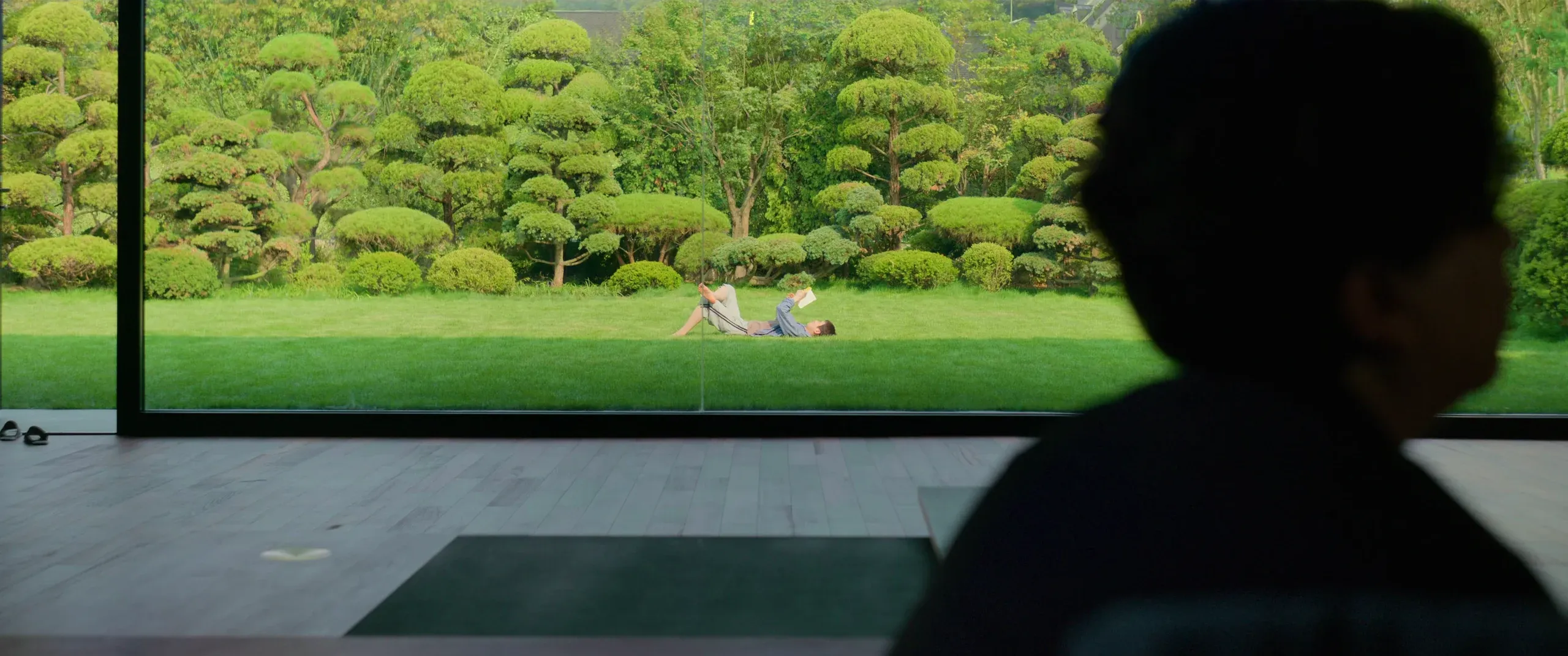 The glass wall · the Parks
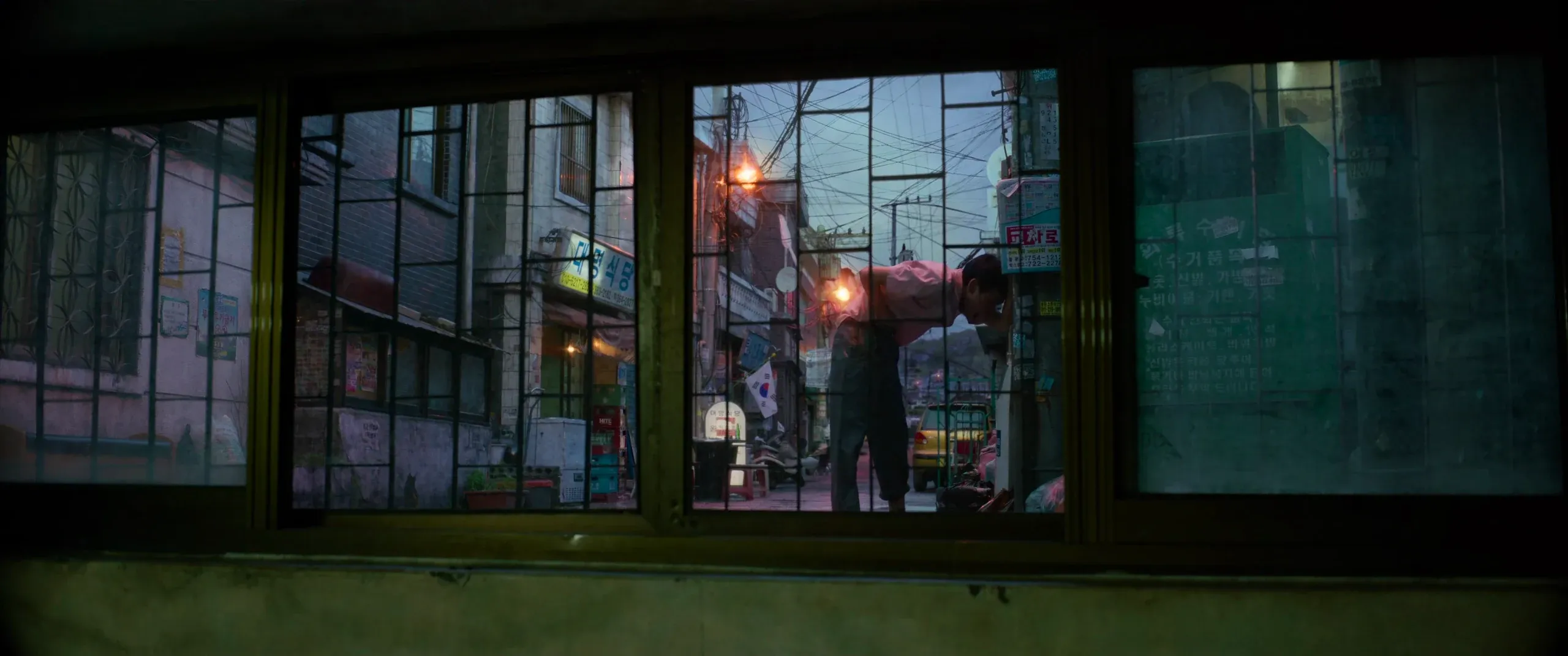 The street window · the Kims
Twenty-four centuries ago, Plato imagined humanity as prisoners “living in a underground den, which has a mouth open towards the light,” able to see only shadows of the things that pass outside (Republic, book 7). The banjiha is his den, built to code. Its mouth opens onto the light at the height of a passing shoe. The Parks watch the world. The Kims are watched by it. The man in the bunker has no window at all.
Who owns the sun
Light in Parasite is property. Bong has said the poorer you are, the less sun you get, and that a semi-basement might catch fifteen to thirty minutes of it a day (IndieWire). At Cannes he described the strange hope that comes with it. Banjiha tenants believe they live above ground, he said, because for a moment each day the sun reaches them, and they fear that if they sink any lower they will lose it for good (Korea Herald).
The film opens on exactly that moment. Hong waited for natural light, bounced off a passing car, to come through the damp socks hanging in the Kims’ window (Cine21). The rest of their day is lit by cheap, greenish fluorescent tubes. The Park house has sun all day through wide glass, and the first time Ki-woo sees Mrs. Park, she is asleep at the garden table in full sunlight. Hong called the Parks’ light aesthetic and the Kims’ light technical (IndieWire). One family’s light is for beauty. The other’s is for getting by.
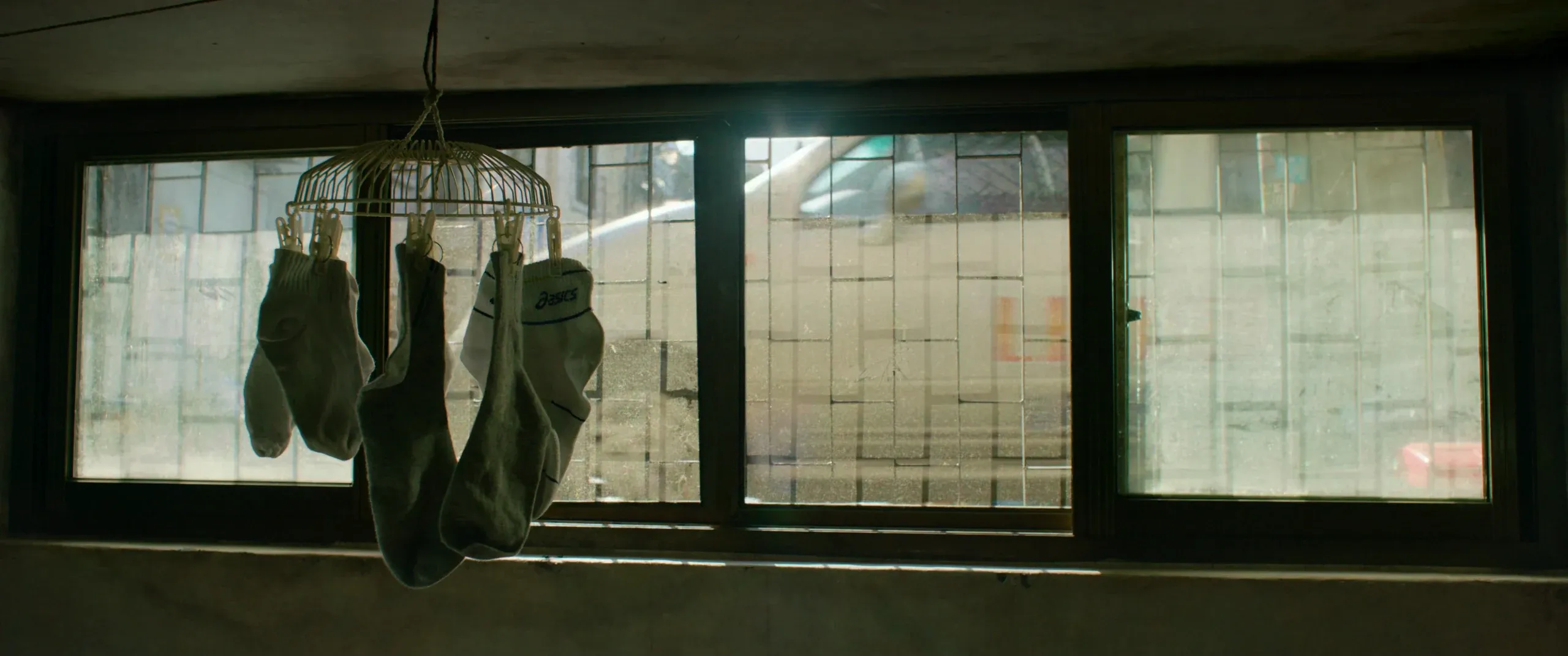 A few minutes · the Kims
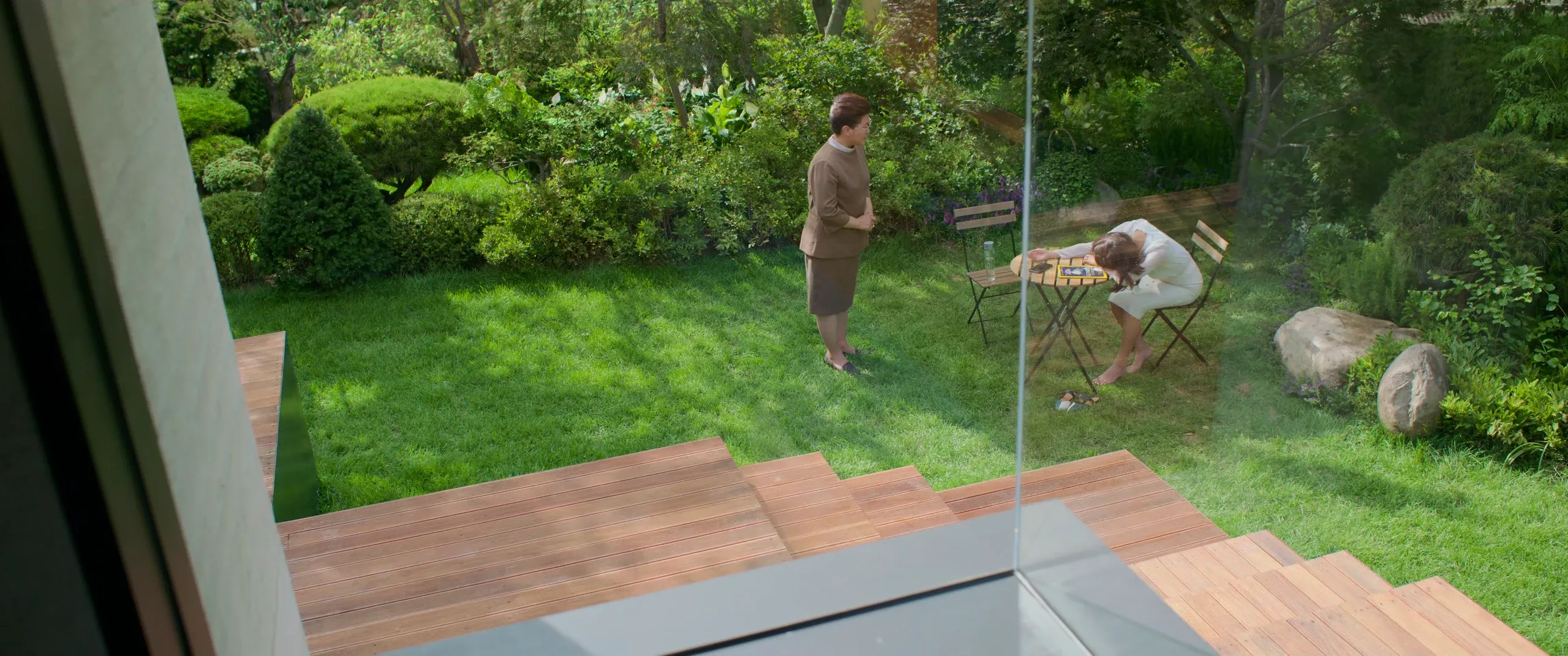 All day · the Parks
The line
Mr. Park has one rule, and he keeps returning to it. People should not cross the line. He complains that the old driver crossed it in the back seat of his car. He praises Moon-gwang for never crossing it, and he tells Ki-taek, from the back seat, that he can’t stand people who do. Bong has said the film is about the invisible class lines of modern capitalism, which cannot be crossed, and about what happens when the classes come close enough to feel each other’s breath (press notes).
The car is where that rule is clearest. Ki-taek drives, facing forward. Mr. Park sits behind him, talking to the back of his head. The line is the seatback between them. Thorstein Veblen, the economist who coined “conspicuous consumption,” put the rule in a sentence in 1899: “The first requisite of a good servant is that he should conspicuously know his place” (The Theory of the Leisure Class).
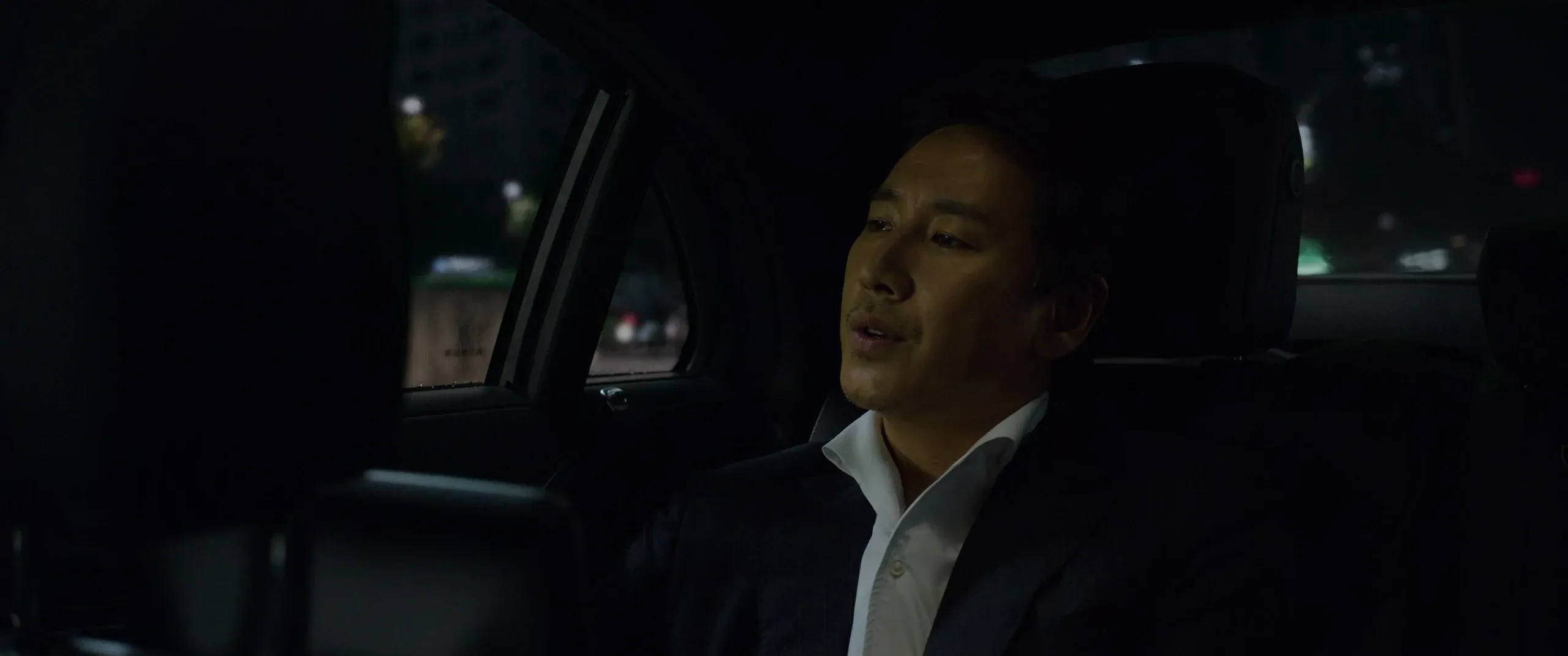 Front seat, back seat
Under the table
The night of the storm, the film draws its whole building in one room. The Parks lie on the sofa, watching Da-song’s teepee in the rain. A few feet below them, under the coffee table, the Kims lie pressed to the floor, unable to move. Mr. Park, not knowing he has an audience, gives his verdict on the driver. The man never quite crosses the line, he says, but his smell does. He searches for a comparison and lands on a rag being boiled, or the people who ride the subway.
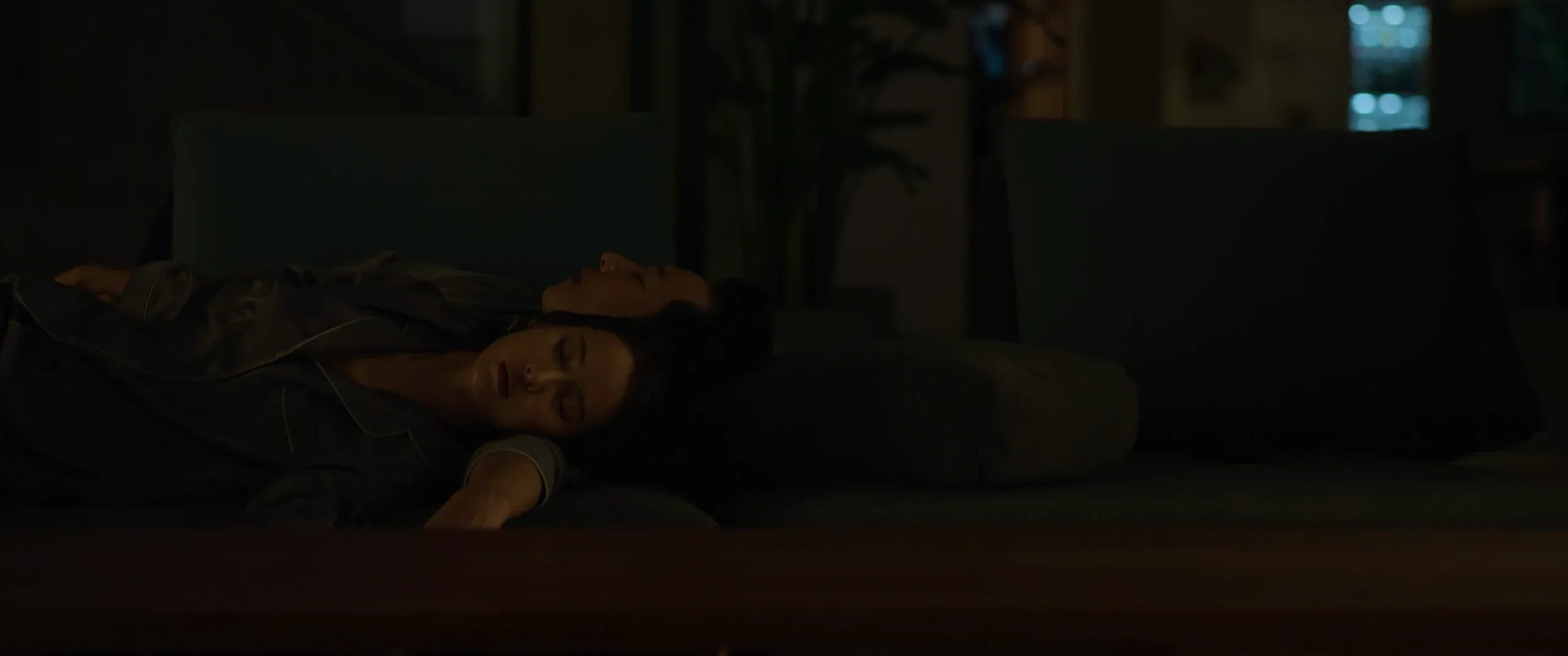 Above · the Parks
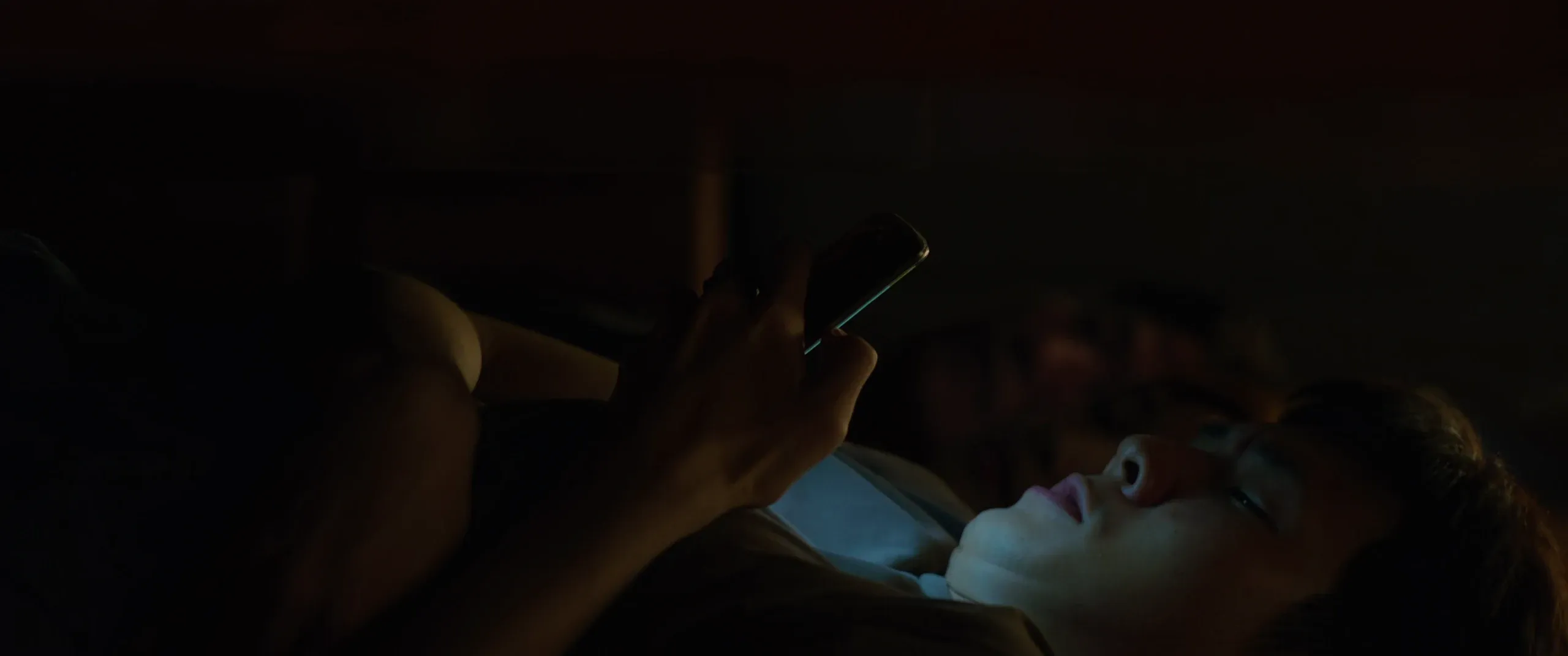 Below · the Kims
The Gospel of Luke has a parable for this picture. A rich man feasts every day, while a beggar named Lazarus lies at his gate, “desiring to be fed with the crumbs which fell from the rich man’s table.” After death their places reverse, and Abraham tells the rich man that “between us and you there is a great gulf fixed” (Luke 16). In Bong’s version there is no gulf. The poor aren’t at the gate. They’re under the table, close enough to hear every word, and the distance between the two families is the thickness of a tabletop.
Smell — the line that crosses
Bong has said the rich and the poor rarely smell each other. They live apart, eat apart and travel apart. The only time it happens is when the poor work inside rich homes, as tutors, housekeepers and drivers (Korea Times). That is exactly the Kims’ situation. They can forge a diploma, invent a cousin and fake a tuberculosis diagnosis. They cannot forge a smell. The first to notice is the youngest. Da-song sniffs his new driver and his new housekeeper and announces that they smell the same.
Thinkers have been here before, and their words are uncomfortable. In 1908 the German sociologist Georg Simmel wrote that the social question is “not only an ethical question but also a question of the nose.” No sight of poverty, he observed, and still less any report of it, overwhelms us as directly as the air that meets us when we step into a cellar dwelling (Soziologie; our translation). A cellar dwelling. Thirty years later George Orwell, an old Etonian, admitted that the middle-class England he grew up in had boiled class prejudice down to “four frightful words”: “The lower classes smell” (The Road to Wigan Pier). Pierre Bourdieu explained why such feelings run so deep. Taste, he argued, is learned in the body before we can choose it, and it shows itself most strongly as disgust. “Taste classifies, and it classifies the classifier” (Distinction).
Mr. Park’s gesture is that disgust made visible. At the party, as he reaches under Geun-sae’s body for his car keys, he pinches his nose. Bong has compared the moment to volleyball. Mr. Park never insulted Ki-taek to his face, but Ki-taek heard him from under the table. The pinch is the toss. The knife is the spike (Cine21).
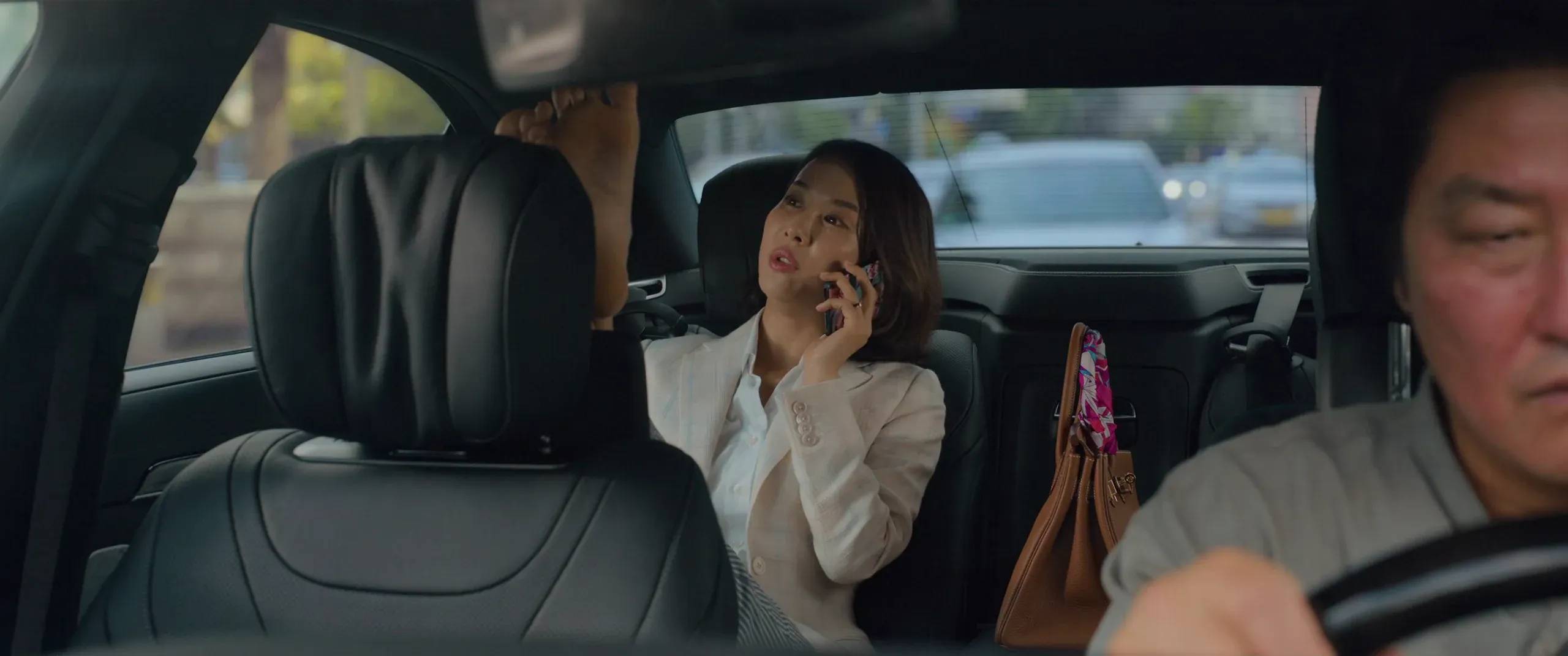 The morning after · the car
One storm, two weathers
The storm is the same storm for everyone. That is the point. For the Parks it is weather. Da-song camps in a tent on the lawn while his parents watch from the sofa. Bong has said the rich look out at the rain and enjoy the mood and the view (Hollywood Reporter). Hong lit the rain at the mansion so faintly it is almost romantic. For the Kims he made it another antagonist (IndieWire). The next morning Mrs. Park is grateful. The sky is blue, the dust is gone, and it’s all thanks to the rain. Her driver spent the night on a gym floor.
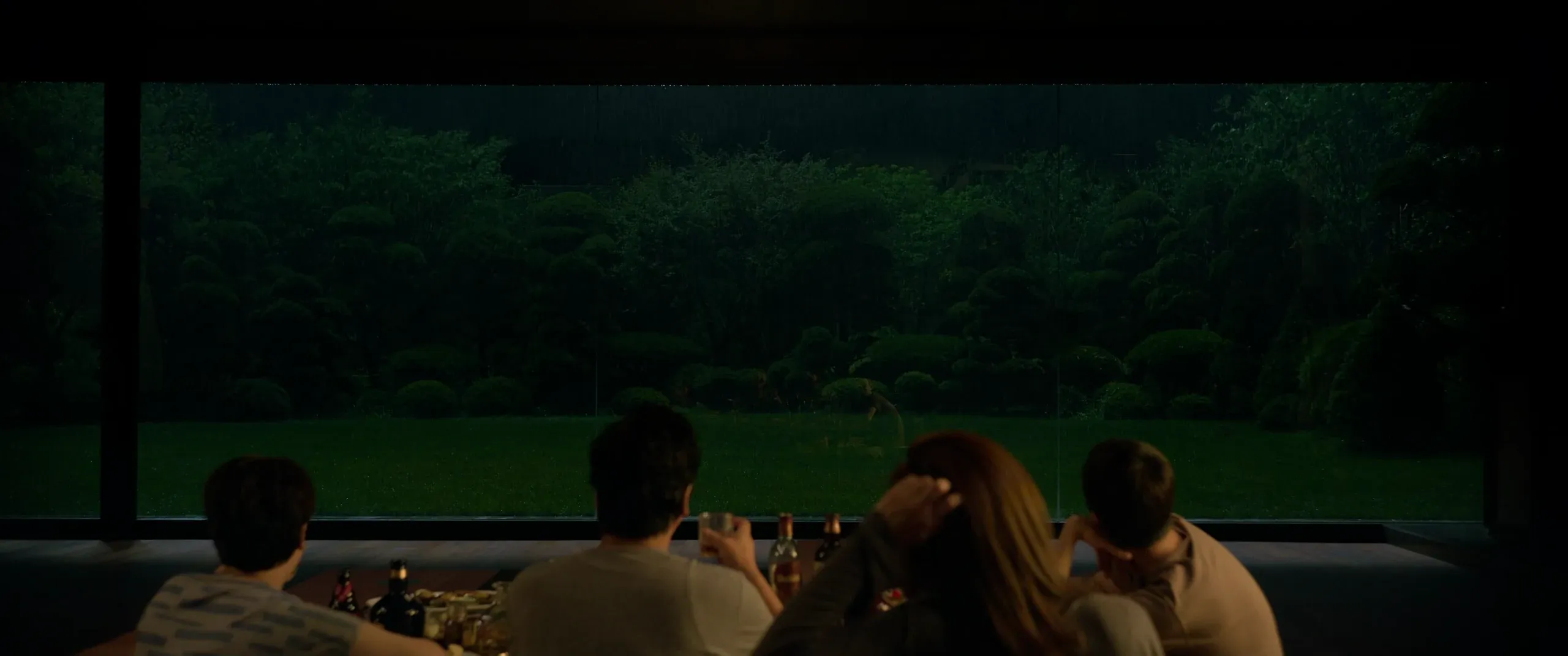 A view · the Parks’ glass
The oldest flood story describes the rain arriving from two directions at once: “the same day were all the fountains of the great deep broken up, and the windows of heaven were opened” (Genesis 7:11). The Kims get both. The window lets the water in from above, and the toilet, the highest point in their home, erupts with water from below. Ki-jung sits on the lid to hold it down and lights a cigarette. The sequence cuts between the flooded bathroom and Moon-gwang, injured and collapsing on the bunker floor. Two families, two rooms below ground, one storm. Genesis sends its flood against the wicked. The Gospel of Matthew notices that God “sendeth rain on the just and on the unjust” (Matthew 5:45). Bong agrees about the rain. What the rain does depends on how high you live.
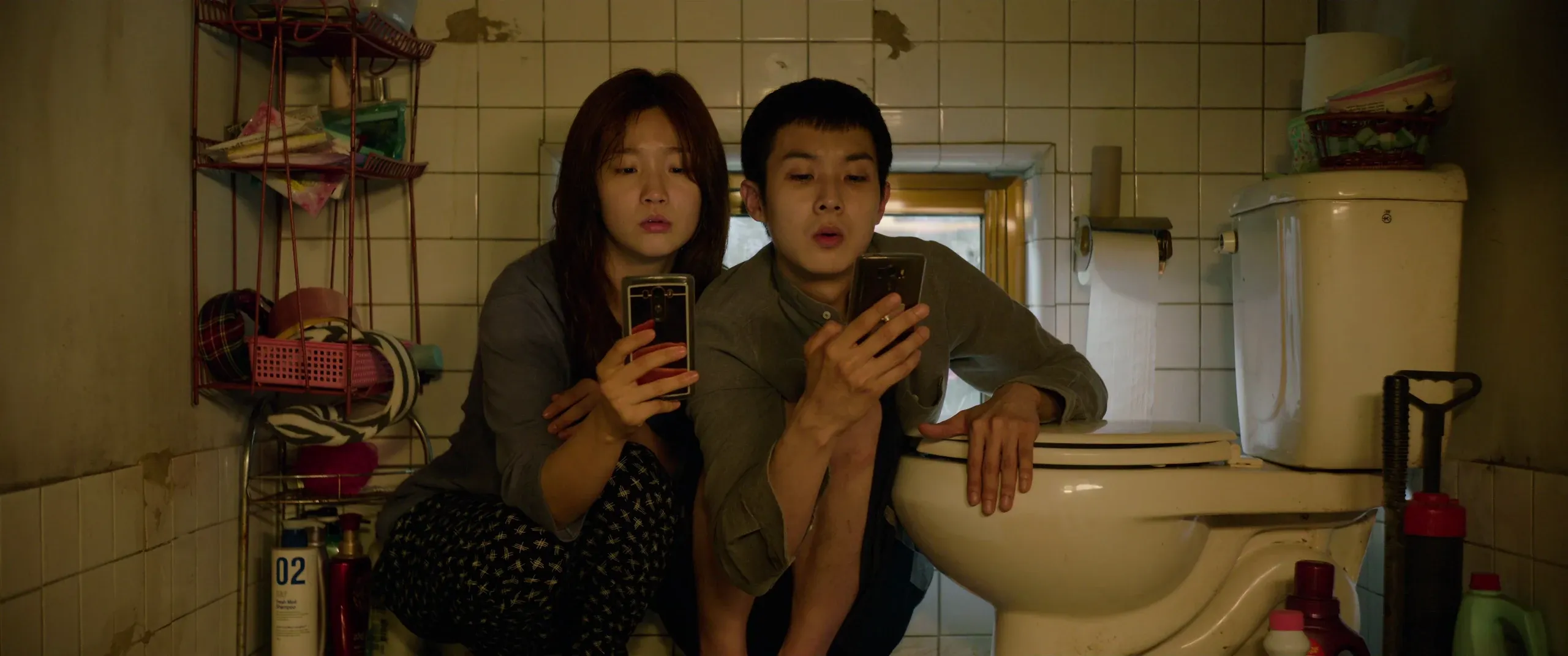 The throne · Wi-Fi
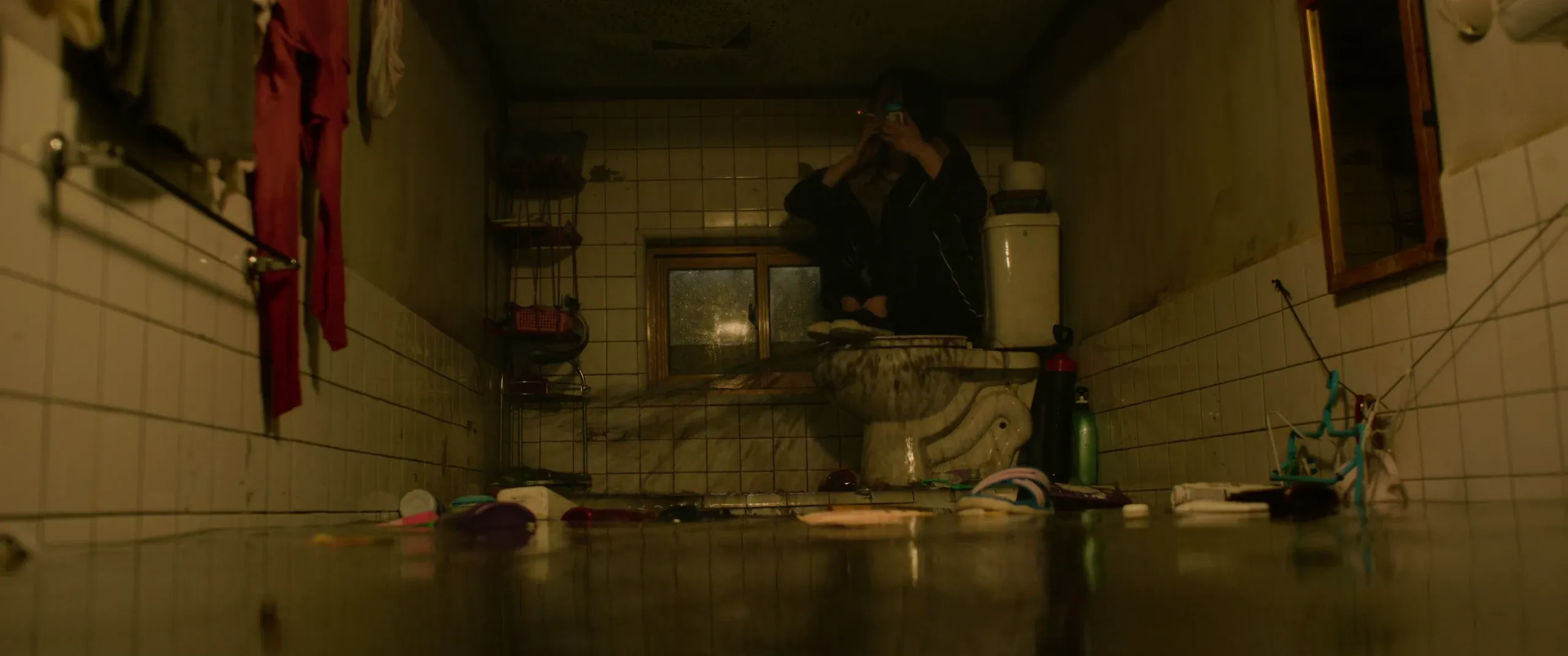 The throne · the flood
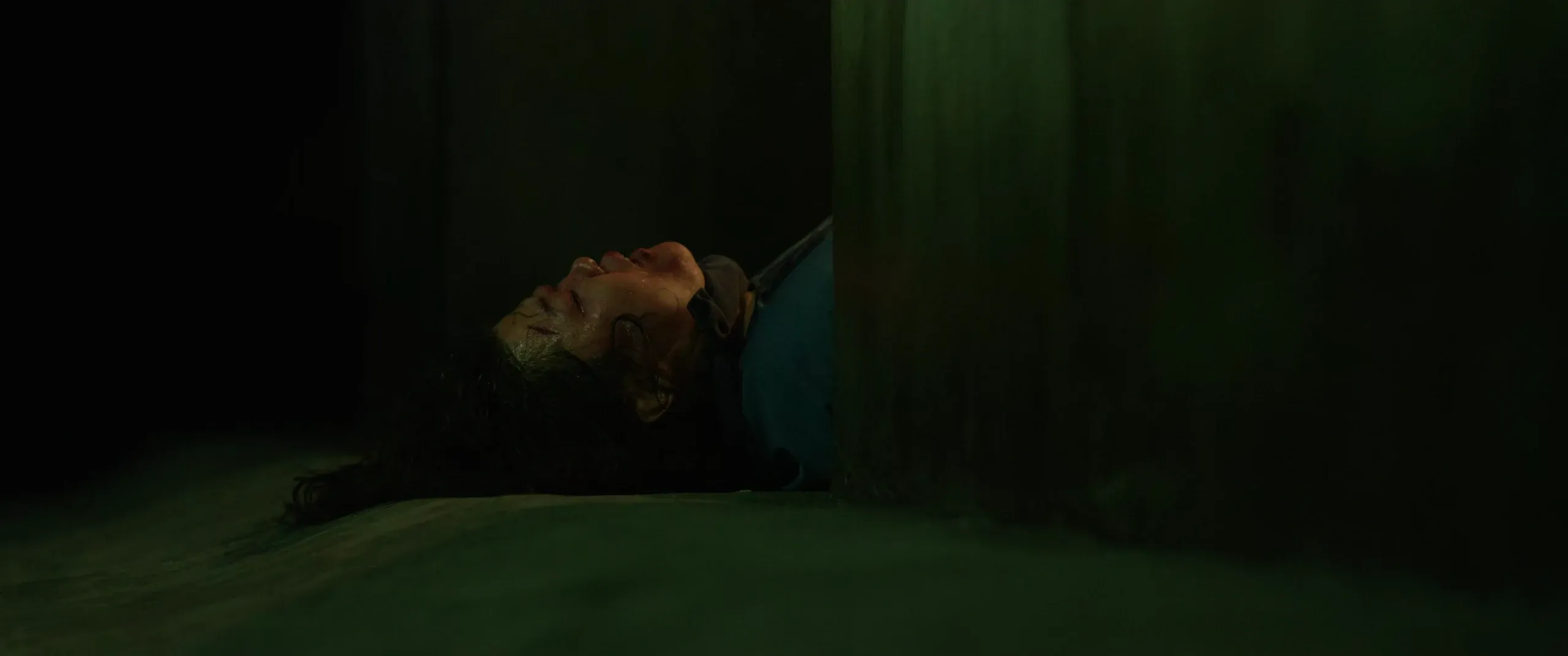 The bunker
The rock — so metaphorical
The rock arrives in the first ten minutes as a gift with a promise. Ki-woo calls it metaphorical, and the film proves him right in the cruelest way. In the flood, the rock rises out of the sewage water into his hands. Bong chose a take in which it seems to float up on its own (Cine21). Ki-woo carries it to the shelter like something saved. On the gym floor he holds it in his arms, and when his father asks why, he says it keeps clinging to him. At the party he takes it down to the basement, and Geun-sae smashes it against his skull. At the end, Ki-woo sets it down in a stream.
Bong has described the relationship exactly. Ki-woo thinks he is holding the rock, but he is really pinned under it (Cine21). It is aspiration in solid form: a promise of fortune that gets heavier the higher you carry it.
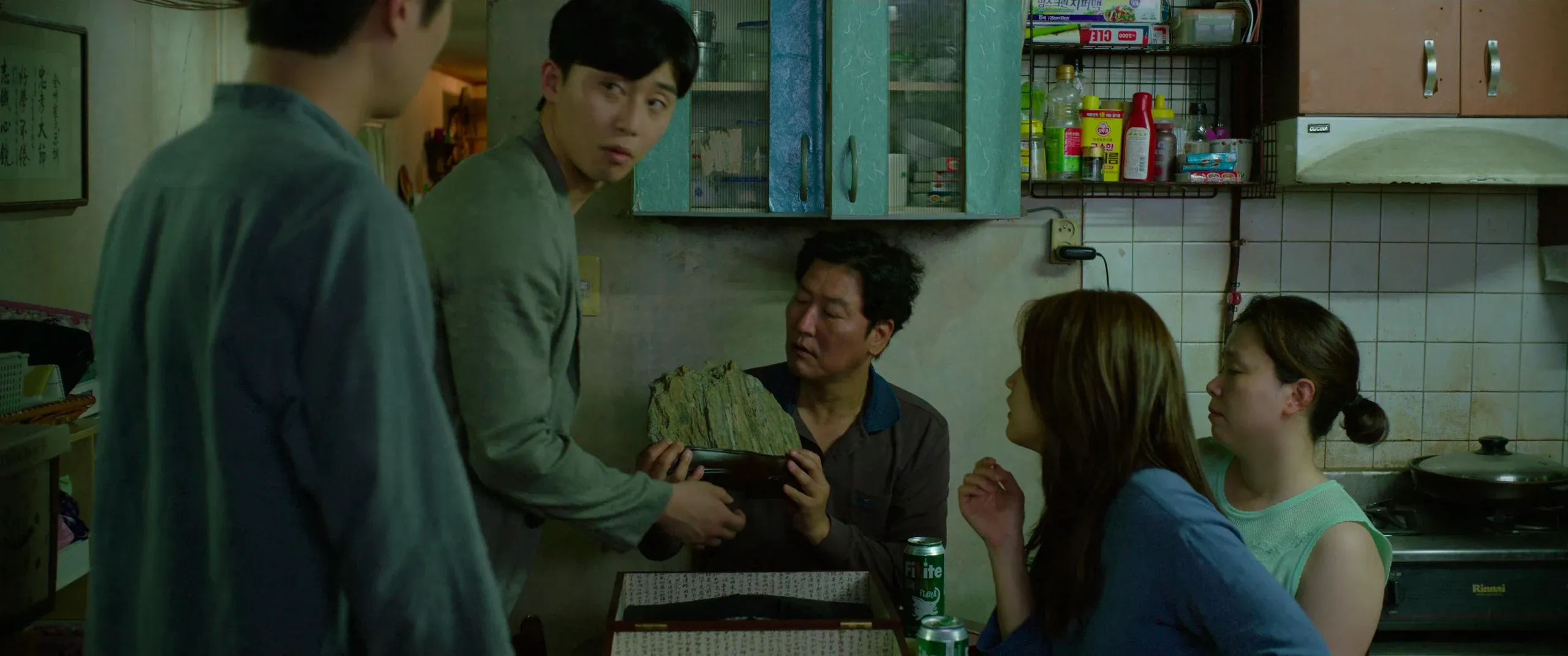 Gift
Gift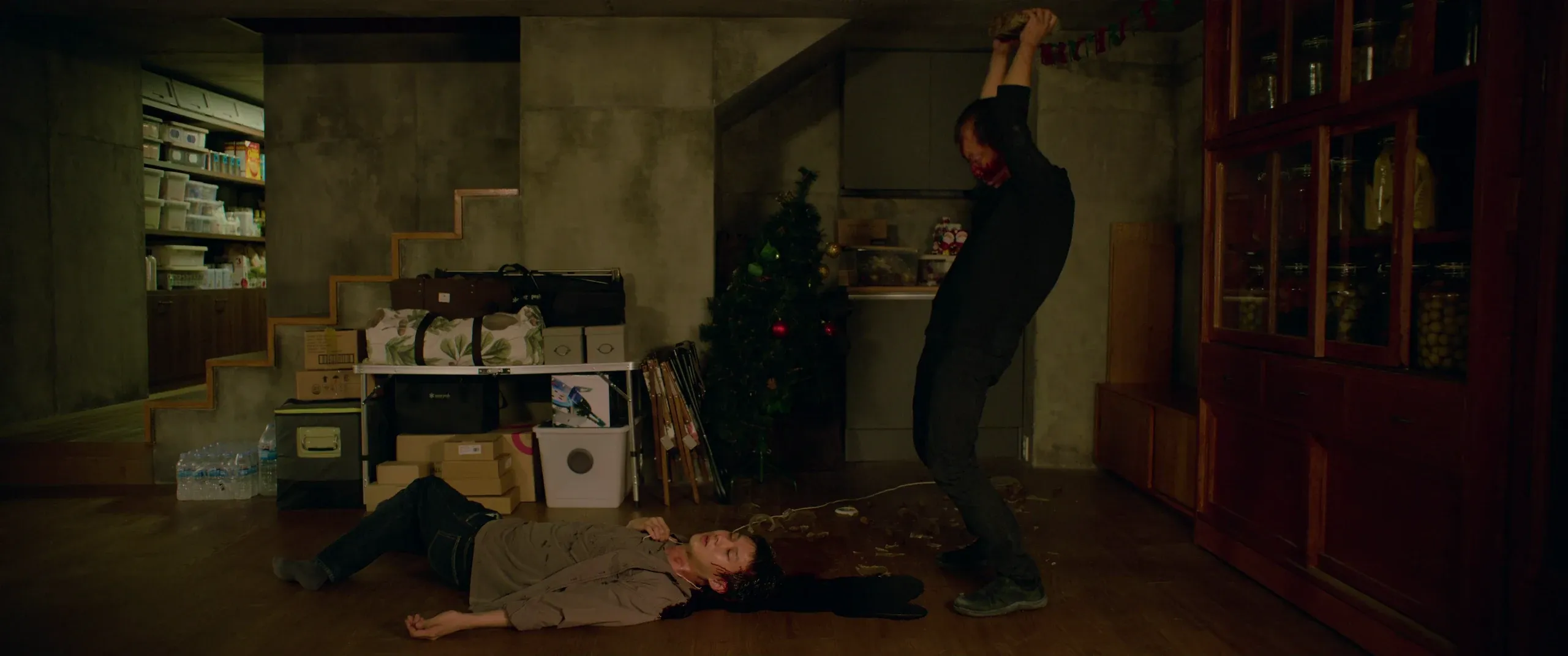 Weapon
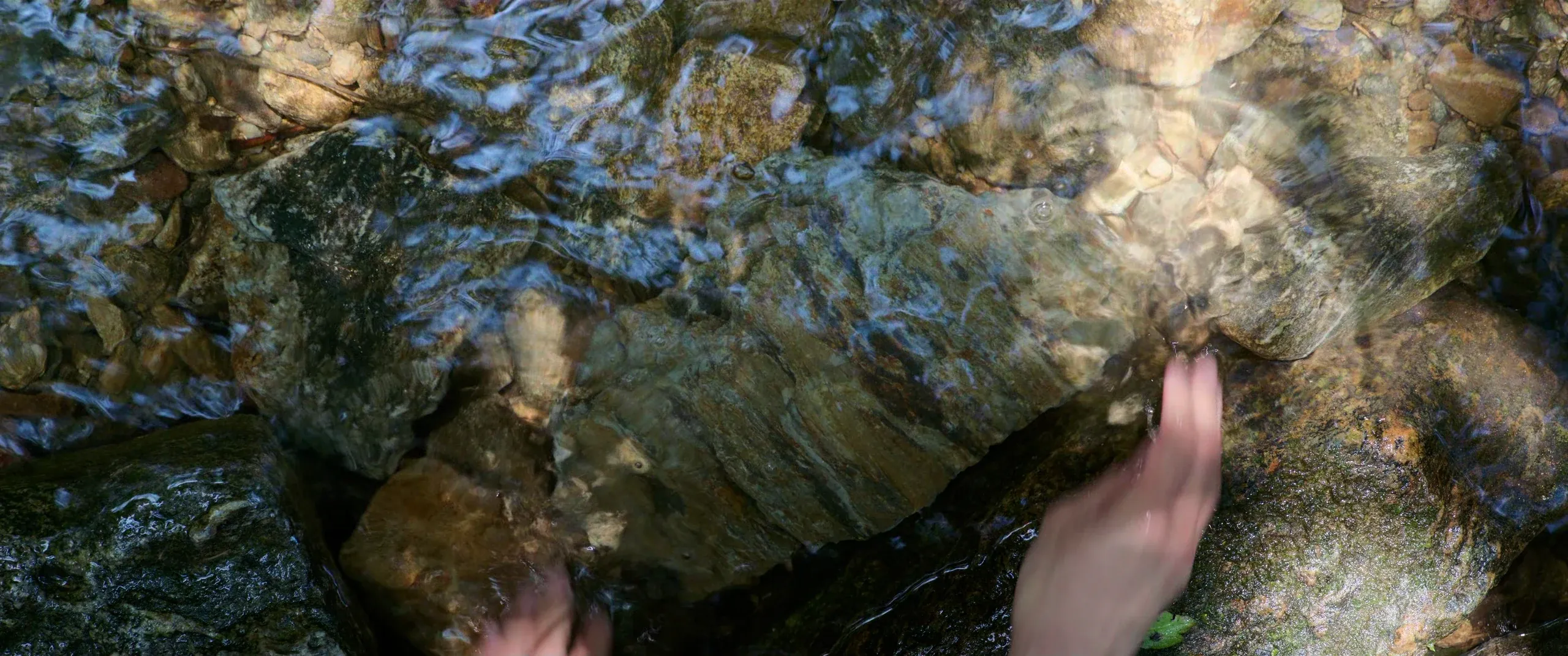 Stone
StoneGreek myth has a man whose story is a rock and a hill. Odysseus, visiting the dead, watches him at work. “And I saw Sisyphus at his endless task raising his prodigious stone with both his hands. With hands and feet he tried to roll it up to the top of the hill, but always, just before he could roll it over on to the other side, its weight would be too much for him, and the pitiless stone would come thundering down again on to the plain” (Odyssey, book 11). Ki-woo carries his stone up the hill to the rich man’s house, and it carries him back down.
Doubles — two families, one basement
The cruelest fights in Parasite are not between rich and poor. They are between the two poor families. When the Kims discover Moon-gwang and Geun-sae, they don’t see allies. They see competition for the same basement. The two households mirror each other almost perfectly. Both fathers failed with castella. Both families hide in the Parks’ house while the Parks are away. Both families fall down the house’s stairs: first the Kims, tumbling into the bunker, then Moon-gwang, kicked from the kitchen into the basement by Chung-sook. Bong has described the film as the semi-basement and the basement fighting each other, until by accident the knife turns upward (Cine21).
René Girard spent his career on why this happens. We learn what to want by imitating others, he argued. When the people we imitate live in another world, like the Parks, there is no conflict; we admire them from a distance. When they live in our world, we become rivals, and rivals grow more alike the harder they fight, until they are mirror images, doubles. Girard also noticed what festivals are for. A feast turns the social order upside down for a day, and in the old stories it often ends in a sacrifice (Internet Encyclopedia of Philosophy). Parasite ends at a birthday party, in costume, with a feast on the lawn and blood on the grass.
Karl Marx saw the same pattern in the labor market. In Capital he describes an “industrial reserve army” of the unemployed, whose competition for the same jobs keeps the employed overworked and obedient. “The condemnation of one part of the working-class to enforced idleness by the over-work of the other part, and the converse, becomes a means of enriching the individual capitalists” (Capital, ch. 25). The Kims never displace the Parks. They displace the driver and the housekeeper.
Nature has a precise name for that strategy. A cuckoo lays its egg in another bird’s nest, and the chick, still blind and naked, pushes the host’s own eggs and young over the edge. The host goes on feeding it for weeks (Davies). The cuckoo doesn’t attack the host. It attacks the other mouths.
The oldest descent myth we have adds a darker rule. In the Sumerian poem of Inanna, the goddess goes down to the underworld and dies there. She is revived, but the judges of the dead will not let her leave until she provides a substitute to take her place below (Inanna’s Descent). Someone always has to be in the basement. By the end of Parasite, Ki-taek has taken Geun-sae’s.
The ghost in the house
The Parks believe their son once saw a ghost. He did. He saw Geun-sae, coming up from the basement in the middle of the night. Sigmund Freud built a famous essay on the German word for this feeling, unheimlich, “unhomely,” usually translated as uncanny. He noticed that its opposite, heimlich, means both “belonging to the house” and “concealed, kept secret,” and he quoted the philosopher Schelling’s definition: the uncanny is what “ought to have remained hidden and secret, and yet comes to light” (“The Uncanny”). The secret of the Park house is a man.
He is a grateful one. Each night, when Mr. Park climbs the stairs, the motion-sensor lights come on ahead of him. They are not motion sensors. They are Geun-sae, below, hitting the switch with his forehead, thanking his benefactor for the food and the roof. “Respect!” Hong rigged the stair lights to flicker whenever someone climbs (Cine21). The light is a message from the floor beneath the floor, in Morse code, and nobody in the house reads it. Da-song, a Cub Scout, starts to decode it and falls asleep (Cine21). Months later Ki-woo, watching from the hill, reads his father’s.
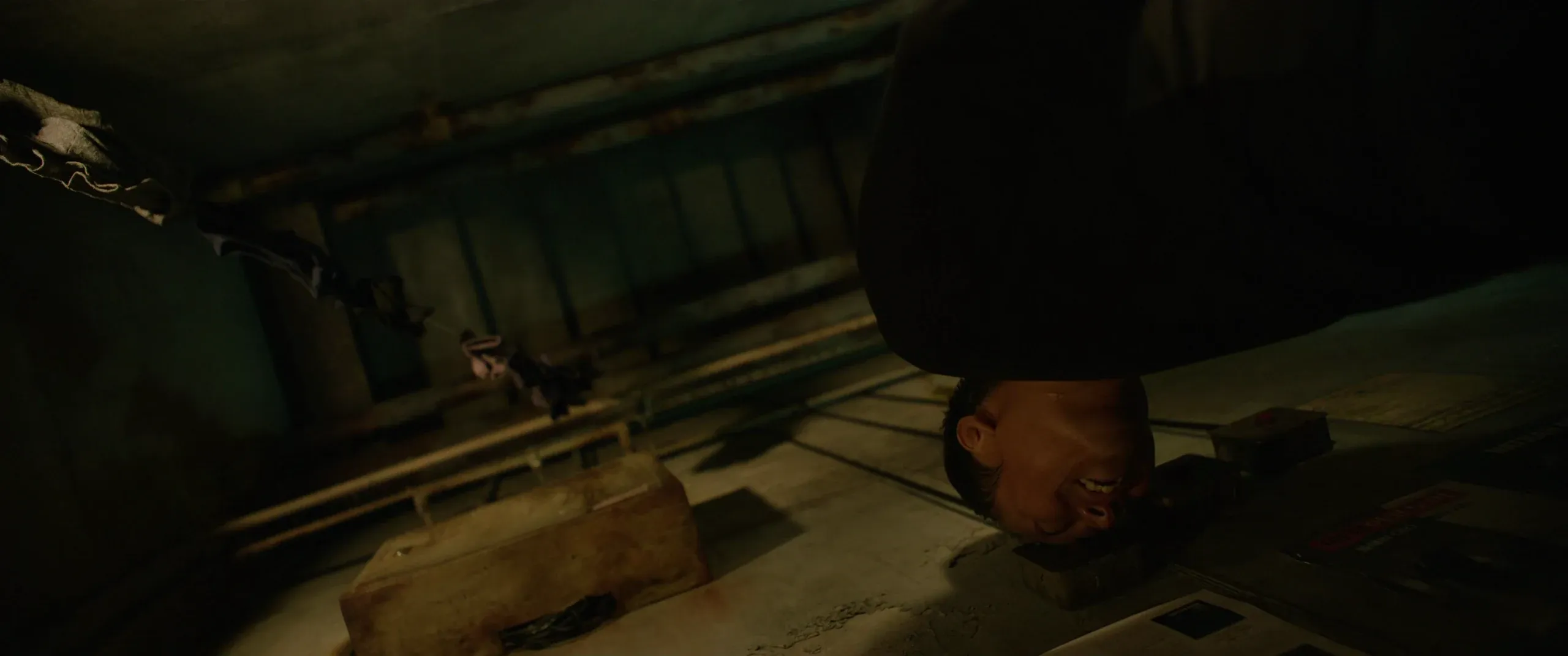 Respect · Geun-sae
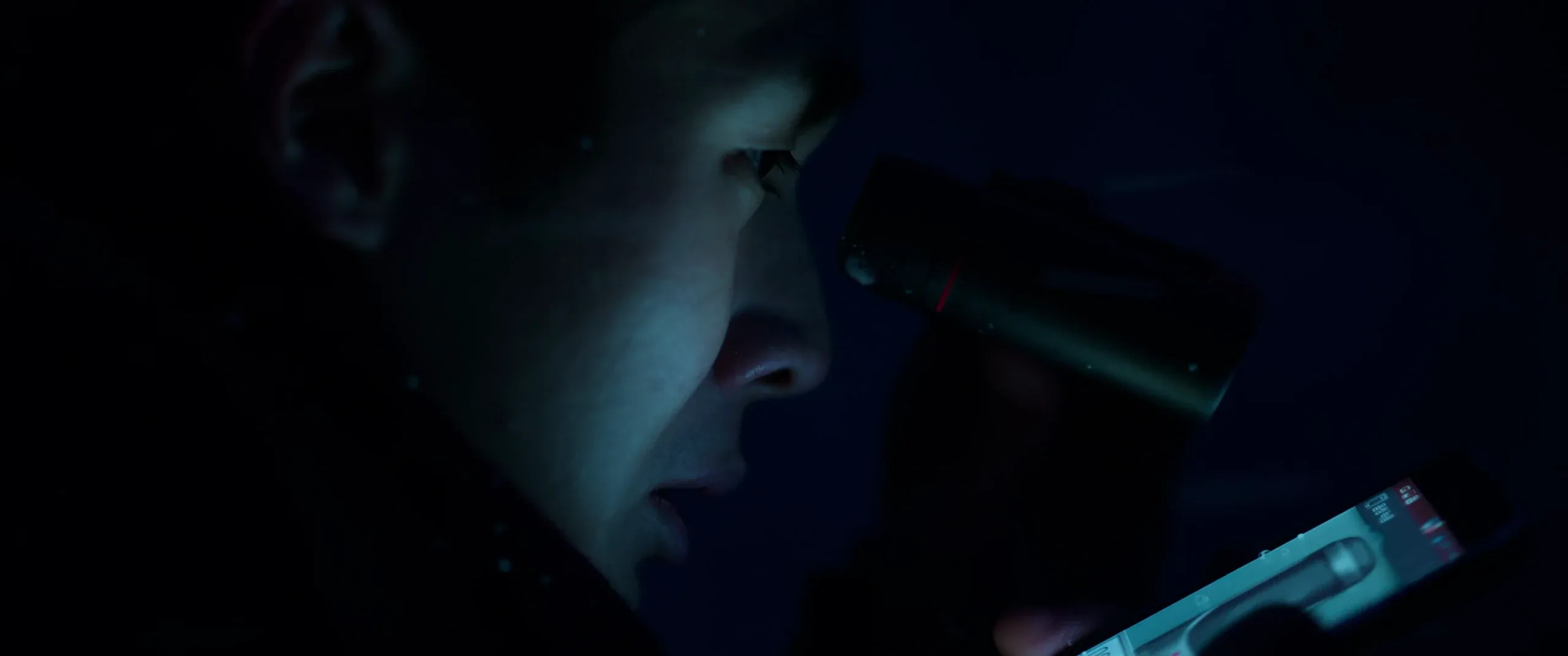 The reply · Ki-woo
Playing Indian
Da-song is obsessed with Native Americans. His arrows were ordered from an American website, and his teepee stands on the lawn. Bong has said that to the Parks this is just decoration, the way a Che Guevara T-shirt is just a shirt. Only afterward did he see the other connection: the story of Native Americans is the story of a house where someone was already living when the newcomers arrived (From the Intercom).
At the party, Mr. Park hands Ki-taek a feathered headdress and tells him to think of it as part of the job. It is the line again, in costume. The driver will play the Indian for the boss’s son, and the boss reminds him that it’s work. The newcomers’ game of playing at the people who were there first is staged by a man who doesn’t know who lives under his own house.
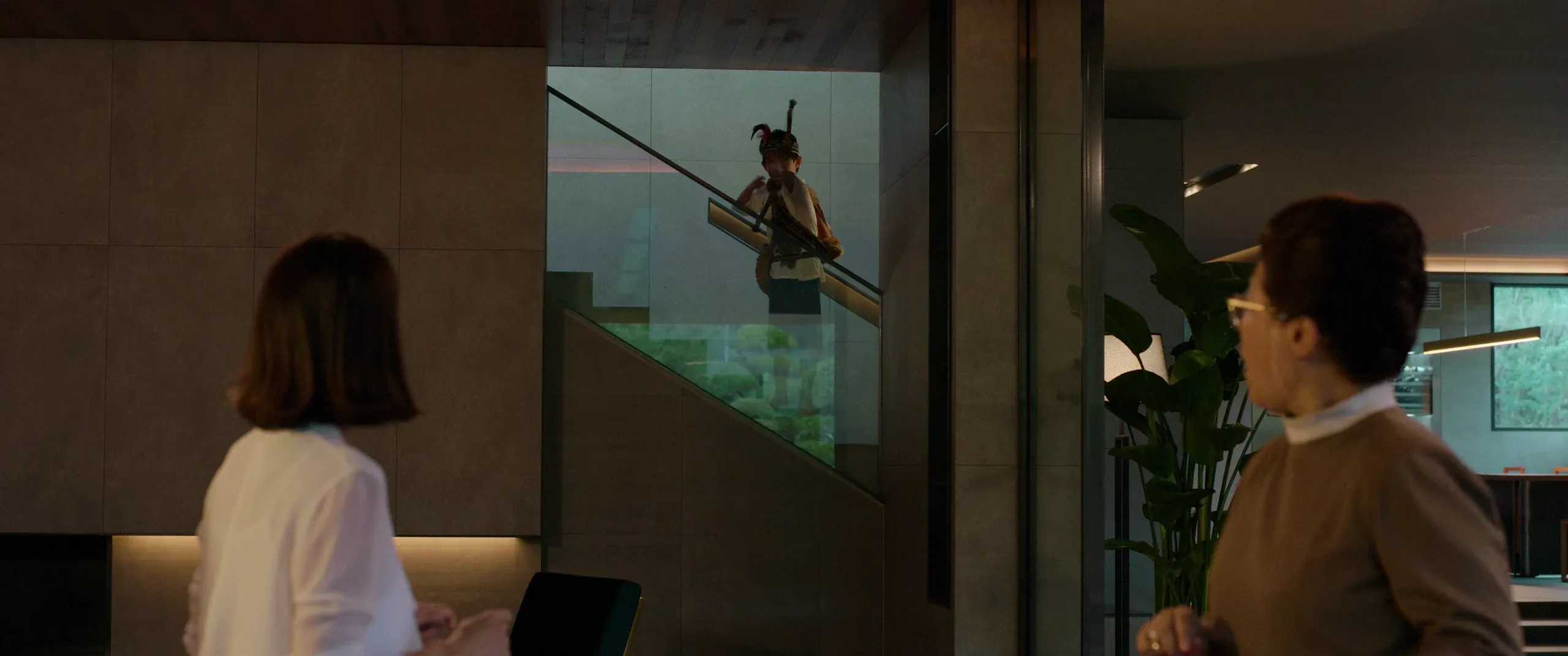 Decor · the arrow
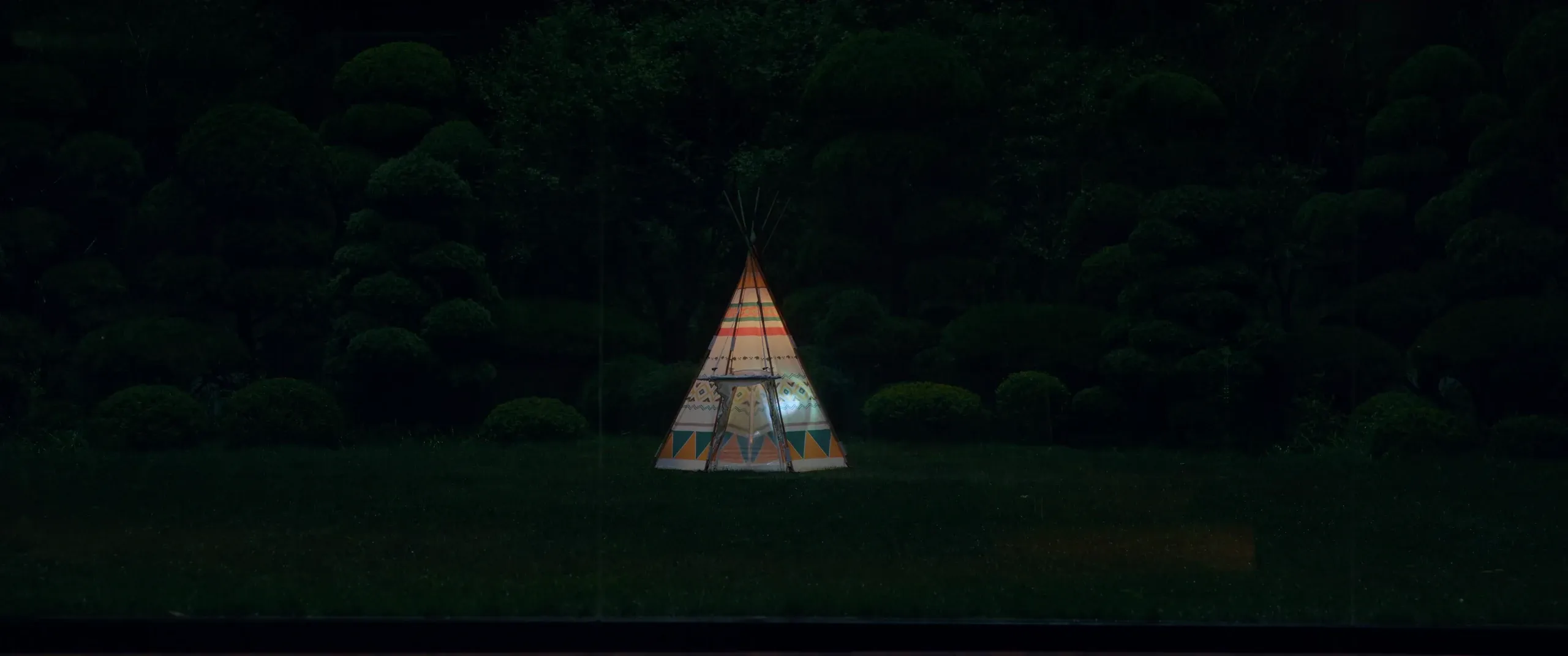 Decor · the teepee
 Costume · the party
The ending — the camera goes down
Parasite begins with a camera move. It starts on the Kims’ window, socks hanging in the light, and descends to Ki-woo, sitting below the street with his phone (Little White Lies). The whole film builds toward the moment it repeats that move.
Months after the party, Ki-woo writes to his father in the bunker. He has made a plan. He will earn money, a great deal of it, and buy the house, and on the day they move in, all his father will have to do is walk up the stairs. The film shows us the plan coming true. Ki-taek climbs out of the basement into the sunlit living room, and his son takes him in his arms. Then the film returns to the semi-basement window, now with snow outside, and the camera moves down from the window to Ki-woo, reading his letter.
Those three images are the film’s whole argument. The only ascent in the last act is a dream, and the camera cancels it with the same downward move it opened with.
The Greeks had a story about a man who tried to lead someone he loved up out of the underworld. Orpheus was allowed to bring Eurydice back to the light on one condition: he must not look back until they had left the dark valley. “The ascending path is mounted in deep silence, steep, dark, and enveloped in deepening gloom,” Ovid writes. Near the top, afraid she might falter, Orpheus “turned his eyes; and immediately she sank back again” (Metamorphoses, book 10). Ki-woo’s letter is an Orpheus plan: lead his father up the stairs into the light. The camera looks back, and Ki-taek sinks back into the dark.
Bong has refused to soften it. It would be crueler, he said, to pretend there is a rosy way out, and he did the arithmetic: saving every won of his salary, Ki-woo would need 547 years to buy the house (Nocut News). According to Choi Woo-shik, the song over the end credits, which he sings, had a working title in the same spirit: “564 Years” (Bedford + Bowery). The two numbers don’t match. The point does.
Existential and Analytical Interpretation
The analytical core — a question of ladders
The film begins from a familiar premise: if you are clever and willing to work, you can climb. Then it tests the premise on the most capable family it can imagine. The Kims are good at everything the house asks of them. They teach, drive, cook, clean and counsel. They get every job they go after. None of it moves them an inch. Competence gets them into the house as staff. It cannot get them into the class.
The turning point is a quiet conversation on a gym floor, among the flood victims. Ki-taek tells his son what kind of plan never fails: no plan at all. Make a plan and life never goes the way you planned it. Without one, nothing can go wrong, and nothing matters. It sounds like despair. It is closer to a diagnosis. Ki-taek has finally seen the shape of the building.
Who is the parasite?
The title points at the Kims. The film keeps asking whether it should. Biologists define a parasite as an organism that lives on or in a host and feeds at the host’s expense (CDC). The word they use for the whole range of close living arrangements, symbiosis, was coined in 1879 to mean simply “the living together of unlike organisms,” a range in which partners can slide from helping each other to feeding on each other (Biology Open). That slide is Bong’s subject. The household is a symbiosis. The question is who is feeding on whom.
Karl Marx had an answer, and he gave it in gothic. “Capital is dead labour, that, vampire-like, only lives by sucking living labour, and lives the more, the more labour it sucks” (Capital, ch. 10). The Park house is dead labor in Marx’s sense, wealth already made and frozen into concrete and glass, and it stays alive only by drawing in living people to drive, cook, tutor and clean.
G. W. F. Hegel saw a stranger twist in the same relationship. In his Phenomenology (1807), the master who sets a servant between himself and the world ends up depending on that servant for everything, while the servant, through work, comes to know his own mind. “The truth of the independent consciousness,” Hegel concludes, “is accordingly the consciousness of the bondsman” (The Phenomenology of Mind). The Parks cannot drive themselves, cook for themselves or tutor their own children. Min-hyuk describes Yeon-gyo as young and simple, and the Kims run circles around her. The masters are the dependents. The servants are the competent ones.
Veblen had a word for what the Parks are really buying. Beyond the work itself, servants perform what he called “vicarious leisure”: their polished, visible service displays their master’s wealth and his freedom from work. They form “a subsidiary or derivative leisure class, whose office is the performance of a vicarious leisure for the behoof of the reputability of the primary or legitimate leisure class.” And Veblen noticed the catch. Personal contact with these hired people “is commonly distasteful to the occupants of the house, but their presence is endured and paid for” (The Theory of the Leisure Class). That is Mr. Park on the sofa, a century early.
What can’t be forged
Every deception the Kims attempt holds. The certificate passes, the cousin is believed, the tuberculosis is diagnosed from a tissue and a bottle of hot sauce. What gives them away is the one thing they never thought to fake. Bourdieu called it habitus: class carried in the body as posture, taste, accent and habit, learned long before anyone chooses it. You can fake a credential. You cannot fake the body that never needed one.
The anthropologist Mary Douglas explained why the reaction is so violent. Dirt, she argued, is not a substance but a relationship. It is “matter out of place,” and “where there is dirt there is system”: to call something dirty is to say it has broken an order (Public Culture). The Kims become dirt only when they are out of place. Their smell is unremarkable in the semi-basement. In the back of a Mercedes it is a violation. The flood makes the idea literal, putting the sewage where the family sleeps.
The critic Walter Benjamin once wrote, in a sentence that fits this film like a key, that to dwell is to leave traces (“Louis-Philippe or the Interior”; our translation). The Kims are masters of traces. They plant underwear in the car and peach fuzz on the housekeeper, and they erase themselves from rooms in seconds. The one trace they cannot erase is the one their home leaves on them.
The anger moves sideways, then up
Bong has described the film’s anger passing like a baton in a relay race: from the basement to the semi-basement, and from the semi-basement to the ground floor (Cine21). For most of the film it travels sideways. The poor fight the poor, as Marx and Girard would have predicted, over the right to live under someone else’s house. Chung-sook kicks Moon-gwang down the stairs. Geun-sae comes up with a knife for Ki-jung, not for Mr. Park.
Only at the end does the knife turn upward, and even then almost by accident. Mr. Park pinches his nose over a dead man’s body. Ki-taek sees it. It is the sofa conversation again, made visible, and this time he is not under the table. The violence that follows solves nothing. Girard’s scapegoat was supposed to restore order. Here the order simply absorbs the blood, and the house is sold to new owners who know nothing about the bunker.
No plan — Sisyphus on the hill
The film’s last argument is between a father and a son. Ki-taek’s philosophy is no plan: expect nothing and nothing can betray you. Ki-woo’s is ambition: make a plan, earn the money and climb. The father has given up on the hill. The son wants to climb it for both of them.
Albert Camus wrote the classic modern reading of Sisyphus. For him the stone is the human condition, endless labor toward a summit that can’t be held, and the only honest response is to keep pushing with open eyes. His essay ends: “The struggle itself towards the heights is enough to fill a man’s heart. One must imagine Sisyphus happy” (The Myth of Sisyphus). Ki-woo has put his stone down in a stream. Now he picks up a heavier one, a plan that will take five centuries, and goes back to the bottom of the hill to begin. Camus asks us to imagine him happy. Bong shows us his face in the semi-basement light and lets us decide.
The argument
Seen as a proof, the film is blunt.
Premise 1: The Kims can learn any skill and tell any lie.
Premise 2: Class is not a skill or a story. It is a place, and the body remembers it.
Conclusion: The Kims can enter the house, but they cannot rise in it.
Premise 3: In this house, everything that moves freely moves down: rain, sewage, falling bodies.
Therefore: When the system shakes, the cost lands on the people already at the bottom.
Conclusion — the shelter and the flood
The banjiha was built for a war that never came. Then the poor moved in, and the shelters became homes, and for decades the homes kept their original promise to their tenants: in an emergency, this is where you go down. In August 2022 the emergency came, and it was water.
Parasite saw it first, because it was looking at the building rather than the people in it. The Kims are not victims of a villain. The Parks are not cruel. “Money is an iron,” Chung-sook says of them; it smooths out all the creases. The film argues something colder. The building does the work. Height is assigned, sunlight is rationed, and water knows the way down. The man at the bottom of the house lights the way up for the man at the top, and calls it respect.
The film ends where it began, under the street, with a boy looking up at a window that gets a few minutes of sun a day. He has a plan. He has put down the rock. He hasn’t put down the weight.
“It keeps clinging to me.”