“How am I to know that I don’t really want what I want, or that I really don’t want what I don’t want?”
In the twenty-second chapter of Genesis, God tells Abraham to take his son, his only son Isaac, whom he loves, into the land of Moriah and offer him there as a burnt offering. Abraham rises early, saddles his donkey, cuts the wood and sets out. “Then on the third day Abraham lifted up his eyes, and saw the place afar off” (Genesis 22). He doesn’t explain himself to anyone. He keeps walking.
In 1843 a Danish philosopher wrote a whole book about that walk. Søren Kierkegaard published Fear and Trembling under a pen name, Johannes de silentio, John of silence, and gave him a strange confession to make. Johannes can describe faith, and he admires it more than anything. He understands what Abraham did: he gave his son up completely and believed, at the same time, that he would get him back, “by virtue of the absurd.” But Johannes admits he can’t make that movement himself (Fear and Trembling). Faith, for Kierkegaard, is not the end of an argument. It is a leap, and nobody can take it for you (Stanford Encyclopedia). Andrei Tarkovsky’s Stalker (1979) follows three men on a day’s walk to a place like Moriah: a room where your deepest wish comes true. All three reach the door. None of them goes in.
The Plot
Stalker has no timelines to braid. It is one journey, told almost as it happens: out of a town, across a forbidden country, to the door of a room, and home again. Its people have no names. They are called by what they do.
Before any of them appears, a card fills the screen: an interview with a Nobel laureate, Professor Wallace. Something came to their small country, a meteorite or a visitation from outer space, and left behind “a miracle of miracles: the Zone.” Troops went in and none came back, so the Zone was sealed off with police cordons. That was probably the right thing, he says, “although I’m not sure.” The film begins with a scientist admitting he doesn’t know. It never settles the question for him.
The town — a house by the railway
The town is filmed in sepia, the brown of old photographs. The camera drifts through glass doors into a bedroom where a family sleeps in one iron bed. On the seat of a chair beside it stand a glass of water, a syringe in a sterilizer and a few pills. A train approaches, and the glass begins to shiver and slide. Remember that glass. The film ends with one.
The Stalker (Alexander Kaidanovsky) slips out of bed, shaven-headed, careful not to wake his wife (Alisa Freindlich) or their daughter, whom everyone calls Monkey (Natasha Abramova). His wife catches him in the kitchen. He has already served five years for taking people into the Zone, and next time it will be ten, she tells him, and she will be dead by then. He answers that he is imprisoned everywhere. When he goes, she falls to the floor and writhes there, sobbing.
Outside a bar by the tracks, the Writer (Anatoly Solonitsyn), drunk and charming, is lecturing a woman in a fur coat. The world is unbearably boring, he tells her. There’s no telepathy, no ghosts, no flying saucers. The world is ruled by cast-iron laws, and they can’t be broken. She drives away. Inside, the Stalker introduces him to the Professor (Nikolai Grinko), a quiet, balding man with a rucksack. Neither man gives his name. “Your name’s Writer,” one of them is told; the other is “Professor.” The Writer says he has lost his inspiration and is going to the Zone to beg for some. The Professor says only that, in a sense, he is a scientist.
They break in behind a freight train, under fire from the guards. Waiting in a dark shed, the Writer admits the talk of inspiration was a lie. The truth is worse: he doesn’t know what he wants. How could he name it, he asks, or know that he doesn’t really want what he wants? His consciousness wants vegetarianism to triumph; his subconscious longs for a juicy steak. “So what do I want?” Then the three men ride a motorized railcar down the tracks into the Zone. The camera holds on the backs of their heads for minutes on end, the wheels clacking. When the railcar stops, the film turns to color.
The Zone — the long way round
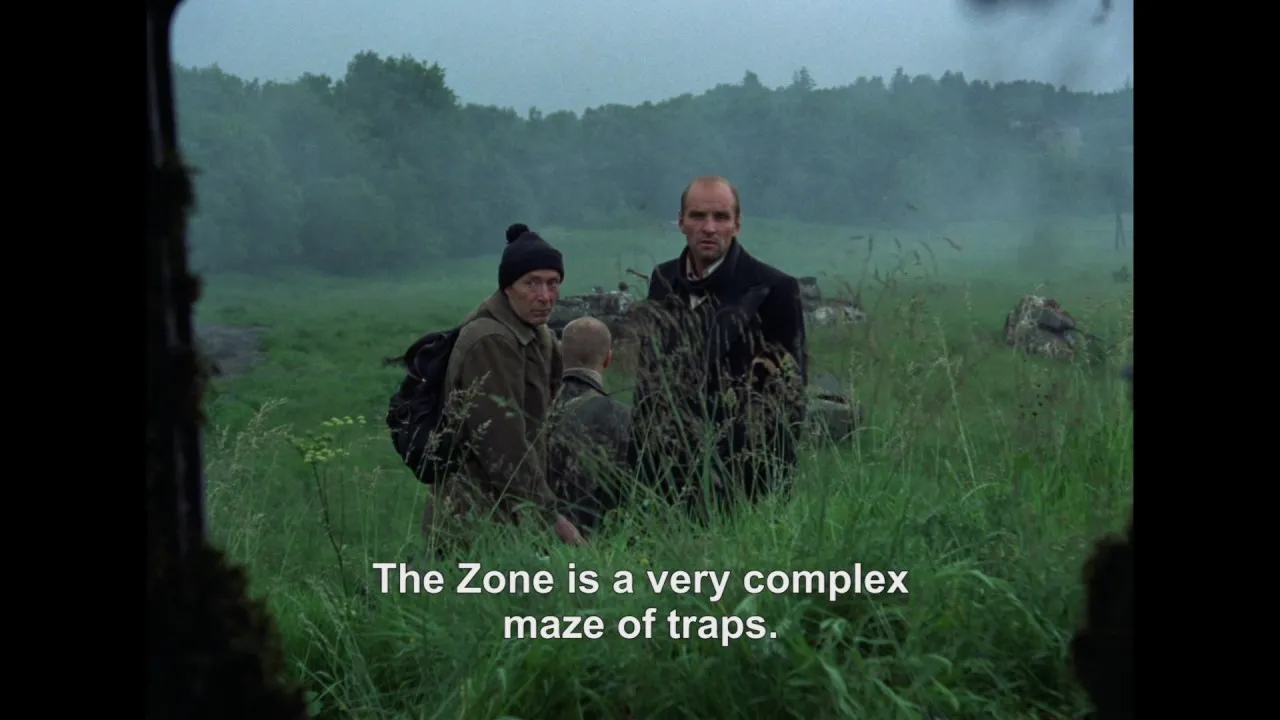
The Zone is green and silent: wet meadows, rusting tanks, telegraph poles hung with broken wire. “Here we are,” the Stalker says, “home at last.” The flowers have no scent. They used to, he says, until Porcupine stamped them out. Porcupine was a stalker too, the man who taught him and “opened my eyes,” until something broke inside him. When the Stalker wanders off, the Professor tells the Writer the rest of the gossip. One day Porcupine came back from the Zone rich, incredibly rich, and within a week he hanged himself.
Twenty years ago, the Professor explains, a meteorite was said to have fallen here. People began to disappear. Then a rumor spread that somewhere in the Zone there is a place where desires come true. A gift, perhaps, from whoever sent it. “Some gift!” says the Writer. “To make us happy,” says the Professor.
The Stalker moves through this country by ritual. He ties strips of white bandage to metal nuts, throws one ahead and walks to where it lands. The house where the Room waits is a stone’s throw away, but nobody walks to it straight. “Straight paths aren’t the shortest here,” he says. When the Writer sets off toward it anyway, a voice from nowhere orders him to stop, and nobody admits to having spoken. The Zone, the Stalker explains, is a maze of traps that rearranges itself the moment people enter it, and at every moment “it’s just as we’ve made it, we and our state of mind.” It doesn’t let the good through, or the bad. It lets through “the wretched.”
The second part opens with the Stalker’s unspoken prayer: let them believe, and let them become as helpless as children. The way goes through a “dry tunnel” that turns out to be a waterfall, and loops back on itself, so that the Professor, who went back for his rucksack, is waiting ahead of them by a fire. A black dog appears from nowhere and does not leave. The Writer and the Professor argue, art against technology, and the Stalker sleeps in a shallow channel while a woman’s voice reads from the Book of Revelation. When he wakes, he recites the road to Emmaus from the Gospel of Luke, then talks about why music moves us.
The worst stretch is a long, dripping pipe the stalkers call the meat grinder. The Writer draws the long match and walks it alone. He survives, and the Stalker, overjoyed, lets slip that Porcupine once sent his own brother through it. Then he recites a poem he says the brother wrote.
The threshold — the Room
In a ruined room near the end, a telephone rings. The Professor uses it to call a colleague and taunt him. He has found something the colleague hid in Bunker Four, and now he is two steps from the place itself. He imagines everyone believing in the Room, and all the “would-be emperors, grand inquisitors, fuhrers of all shades” who would come. The Writer, idly, weaves a wreath of twigs and sets it on his head like a crown of thorns.
At the doorway, the Stalker kneels. This, he tells them, is the most important moment of their lives. Here their most cherished desire will come true, “the desire that has made you suffer the most.” They need not speak. They must only recall their lives, and believe.
The Writer refuses. Recalling his life won’t make him kinder, he says, and it is shameful to humiliate yourself, “to snivel and to pray.” The Professor takes a bomb out of his rucksack, twenty kilotons, and says he means to destroy the Room before it falls into evil hands. The Stalker wrestles him for it, and the Writer beats him off. Bleeding, the Stalker pleads. This is the only place left to come to when all hope is gone. Why destroy faith?
The Writer turns on him. The Stalker enjoys his power here, he says, “power, mystery, authority,” and that is why he never goes in himself. A stalker isn’t allowed in the Room, the Stalker answers: remember Porcupine. The Writer thinks he understands Porcupine at last. He crawled in to beg for his brother and came out with money, because the Room doesn’t grant what you ask for. It grants “one’s most secret desire,” the essence of your nature, which governs you though you don’t know it. Porcupine saw what he really was, and hanged himself. The Writer won’t risk the same. And who told them all this about Porcupine and the Room? The Professor nods at the Stalker. “He did.”
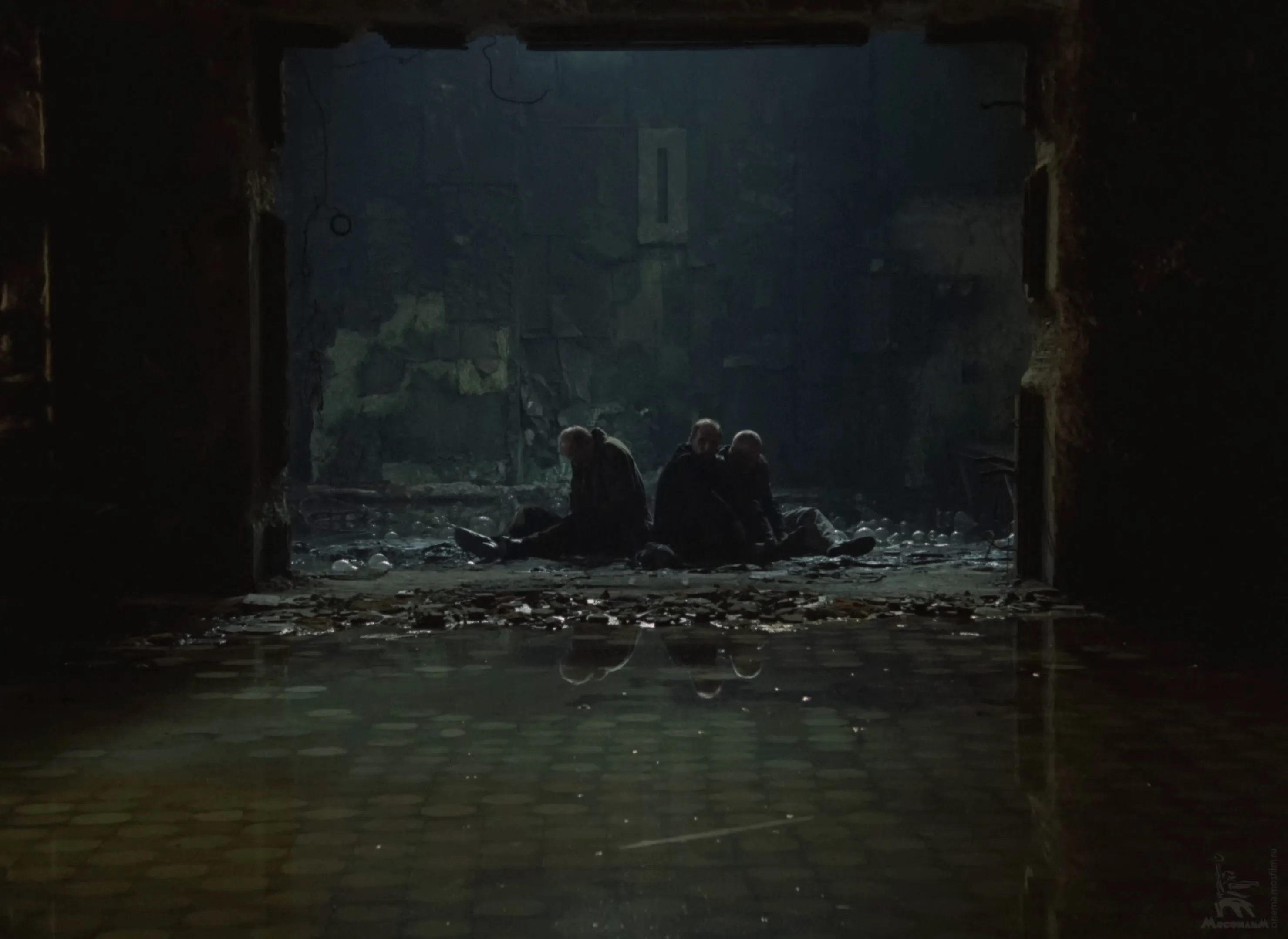
The Professor takes his bomb apart and throws the pieces into the water. The three men sit down together at the threshold. Inside the Room a light comes up and fades, and then it begins to rain. No one goes in.
Home — the wife and Monkey
Back in the sepia bar, the Stalker’s wife comes to collect him. The black dog has followed them out of the Zone, and it goes home with the family. Outside, for the first time, the town appears in color: Monkey, in a golden shawl, rides on her father’s shoulders beside a lake, with a power station smoking on the far shore. She can’t walk. Her crutches stay in her mother’s hands.
At home the Stalker lies on the floor beside the dog’s bowl of milk and despairs. These intellectuals believe in nothing, he says; their capacity for faith has withered from lack of use. Nobody needs the Room. His wife offers to go there with him. Doesn’t he think she has something to ask for? He won’t take her. “What if you fail, too?” Then she sits down by the open door, lights a cigarette, and talks straight to the camera. Her mother warned her against him, she says: he was one of God’s fools, a marked man, a jailbird. She went with him anyway, and has never regretted it. If there were no sorrow in their lives, it would not be better. There would be no happiness, and no hope.
The last scene is in color. Monkey has been reading a love poem by Fyodor Tyutchev, about the lightning in a lover’s glance, and we hear it as she sits at the kitchen table. She looks at a glass of tea, and it slides across the table. So does a jar, and then an empty glass, which falls to the floor. By then she has laid her cheek on the table. A train passes, the room shakes, and music rises through the noise.
Stalker’s Structure and Purpose
Stalker is built like a pilgrimage: out, across and back. Before shooting, Tarkovsky said he wanted the classical three unities of drama, one place, one time and one action, and no time missing between the cuts (in interview, 1977). He later wrote that he wanted the film to seem “as if” it had been “made in a single shot” (Sculpting in Time, p. 194). It runs 161 minutes in 142 shots, more than a minute a shot, by the count of Geoff Dyer, who retold the whole film shot by shot in his book Zona (BFI). The camera doesn’t cut away to the next interesting thing. It waits with the men, and makes us wait too. Tarkovsky’s word for what fills a shot like that was time pressure: the rhythm of a film, he argued, comes not from the length of its pieces but from “the pressure of the time that runs through them” (Sculpting in Time, via Offscreen).
Then the film divides the world in two. The town is sepia, the Zone is in color. Everything was shot on color film, and the town scenes were printed without it (camera mechanic Sergei Bessmertny). The camera stays in sepia on the backs of the men’s heads all the way down the tracks, and color arrives only when the railcar stops, on a green hillside in mist. Inside the Zone, a few moments slip back to sepia: the Stalker seeing himself asleep on an islet, the black dog lying down beside him, his dream. Outside it there is no color at all, until near the end, when the Stalker carries Monkey home along a polluted lake and the town is in color for the first time. She is in it. Hold on to that for the last scene.
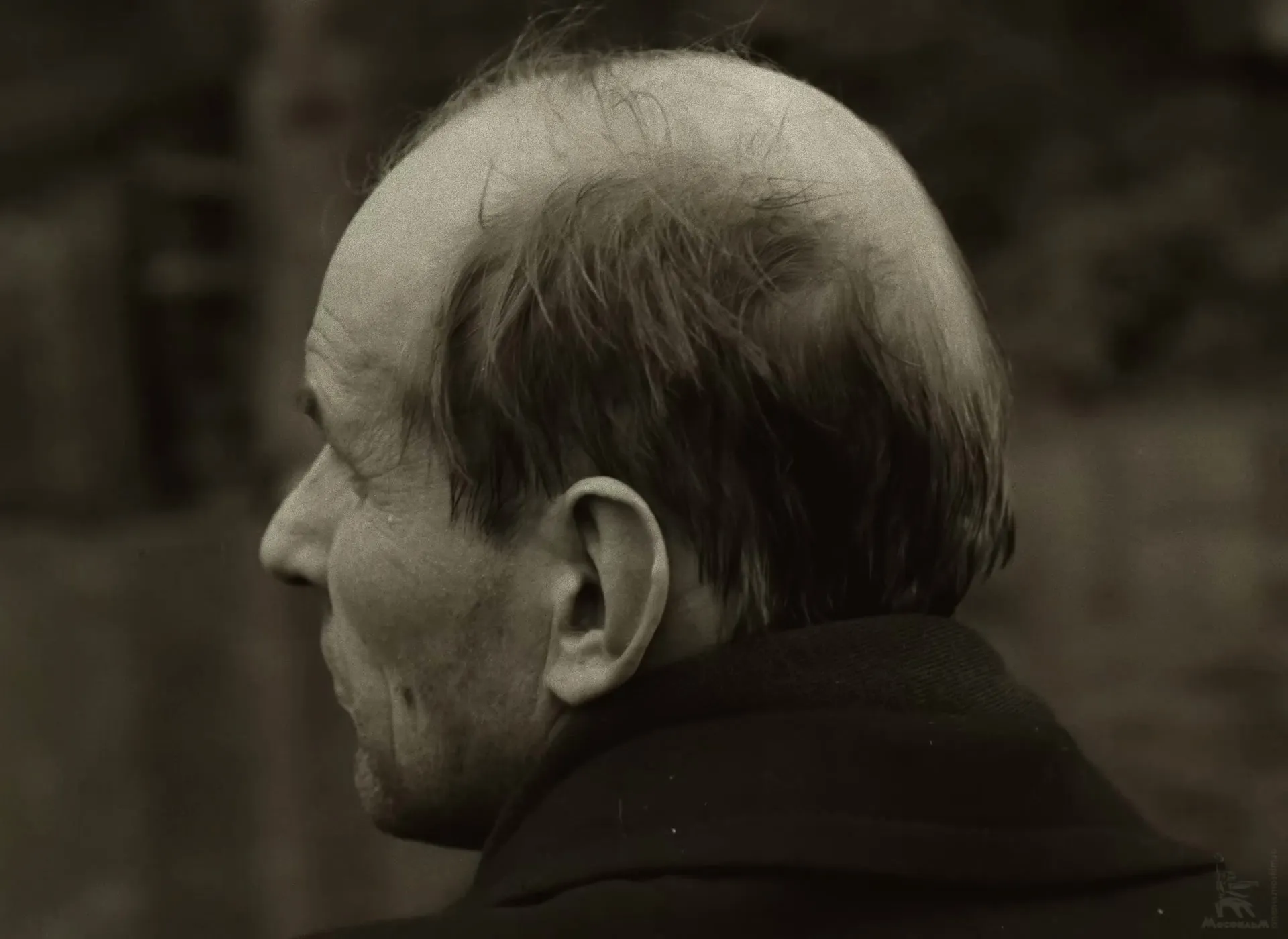 Sepia · the tracks
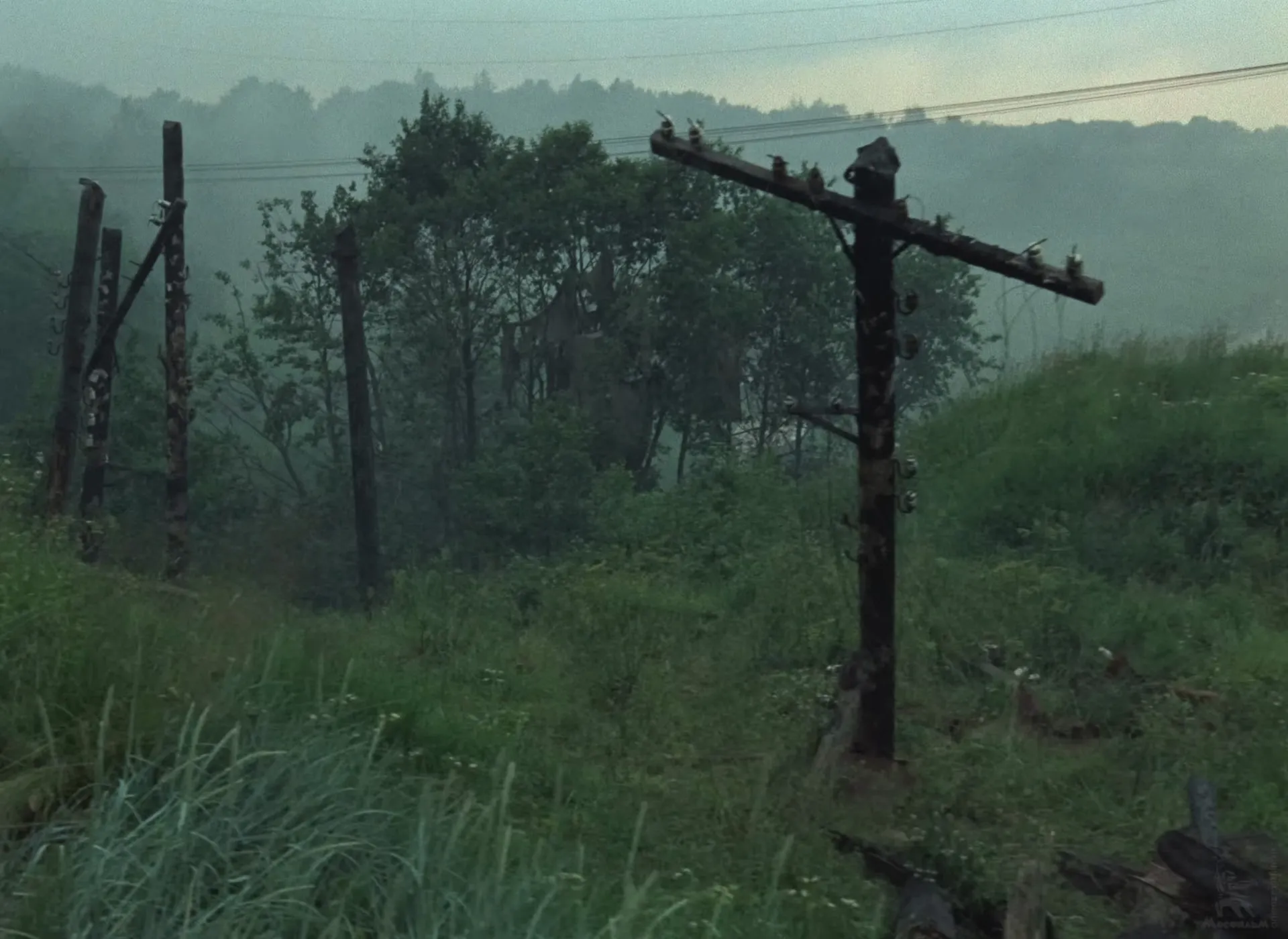 Color · the Zone
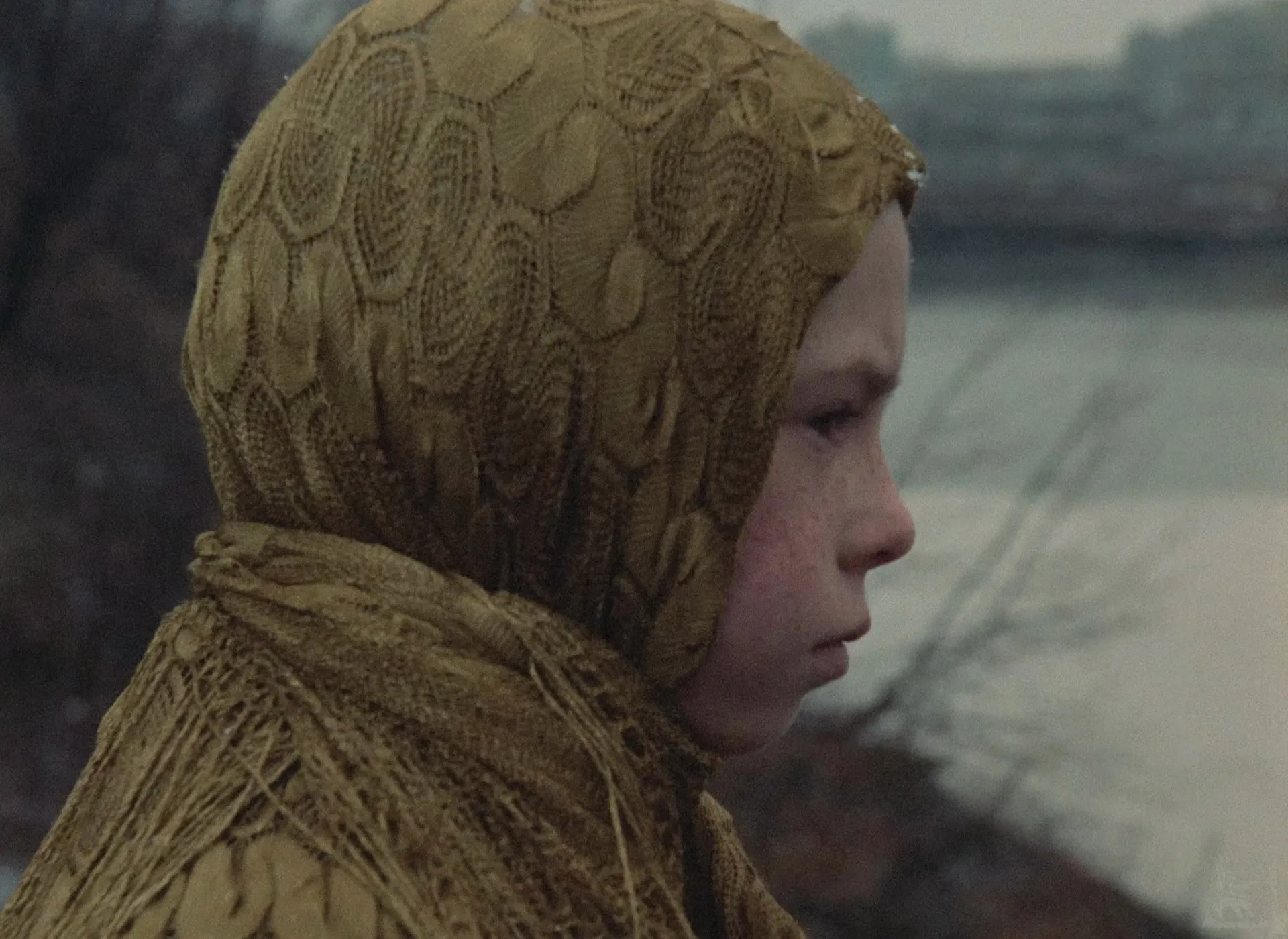 Color · Monkey
The film that was made twice
Stalker had to be made twice. Tarkovsky began shooting in Estonia in the spring of 1977, with Georgy Rerberg, who had photographed Mirror, behind the camera (Criterion). That summer the footage came back from Mosfilm’s laboratory badly flawed. What went wrong has never been settled. A camera mechanic remembered the official finding as a bad batch of imported Kodak stock and faulty processing, and the rushes as “dark and greenish” (Bessmertny). Tarkovsky blamed a lab technician (in interview, 1980). Rerberg left after a bitter quarrel, and said later that he hadn’t run away; he had been removed from the picture (Rossiyskaya Gazeta). By the crew’s accounts a shot or two of his survives, among them white foam blowing off a river poisoned by waste from upstream (Marianna Chugunova).
The disaster changed the hero. In Arkady and Boris Strugatsky’s novel and in the early scripts, the stalker was a tough smuggler. That August, Tarkovsky told the writers he would not make the film with that Stalker. Boris Strugatsky remembered that they thought about it for two days, and invented another stalker, a holy fool (in interview). By November Tarkovsky was telling the Swedish director Vilgot Sjöman that at first the stalker had been “the personification of evil,” who led the curious into the Zone and robbed them, “But more and more I’m seeing him as a tragic figure” (Sjöman’s notes). In April 1978 Tarkovsky had a heart attack (BFI). That summer and fall the film was shot again, almost from scratch, by Alexander Knyazhinsky, and it was released in two parts; the money set aside for the second part paid for the reshoot (editor Lyudmila Feiginova). Tarkovsky came to think the loss had saved the film: fate stepped in, he said, just when it might have turned out “insufficiently deep” (in interview, 1980). A film about a ruined place that might grant one wish had to be ruined itself before it found out what it was about.
A wasteland made by hand
The Zone was supposed to be filmed in Central Asia, until an earthquake in January 1977 left the crew nowhere to stay. They found it near Tallinn instead, around an abandoned hydroelectric station on the Jägala river that the retreating Red Army had blown up in 1941 (James Norton, quoting assistant director Evgeny Tsymbal), and among the old power plants and warehouses of Tallinn itself (BFI). For the first time Tarkovsky took the design credit too (in interview, 1980), and he arranged the wasteland like a still life. “In all shots every blade of grass would be positioned by his own hand,” his sound designer, Vladimir Sharun, remembered (Sharun). His assistant Marianna Chugunova plucked every tiny yellow flower out of a whole meadow because they were in the camera’s view, and Tarkovsky gave up one of his old talismans: the horses that run through his earlier films. “He replaced the horse with a dog,” she said (Chugunova).
The river really was poisoned. Upstream, Sharun said, a plant poured its waste into the water, and many of the women in the crew came out in rashes. Years later he came to believe the location had killed them. Tarkovsky and Solonitsyn both died of lung cancer, in 1986 and 1982, and Larisa Tarkovskaya, the director’s wife and assistant director, of cancer in 1998 (Sharun). It is one man’s belief, and nobody has measured anything. A camera mechanic on the same shoot said he knew of no facts behind it (Bessmertny).
Seven years after the film opened, a reactor exploded at Chernobyl and the land around it was sealed off as an exclusion zone. The people who slip into it illegally now call themselves stalkers, after the novel and the film (National Geographic). It has made the film look like a prophecy. The scholar Robert Bird warns that looking for predictions in Tarkovsky’s films is “sorely to mistake their nature” (Elements of Cinema, p. 9). Tarkovsky would have agreed. “The Zone doesn’t symbolise anything,” he wrote: “the zone is a zone, it’s life, and as he makes his way across it a man may break down or he may come through” (Sculpting in Time, p. 200). It is not a disaster site. It is a test.
The music of trains
Tarkovsky told the composer Eduard Artemyev that he couldn’t stand ordinary film music, and tried with all his strength to get rid of it (Artemyev, in Russian). Stalker has very little. For the main theme Tarkovsky asked for something that would join East and West, and Artemyev found it in a fourteenth-century hymn to the Virgin Mary, Pulcherrima Rosa (Artemyev). It was played on a recorder, with an Eastern lute, over a synthesized drone modeled on the drone of Indian music (Artemyev). A Catholic hymn on a European recorder and an Asian lute, beneath a prayer from a Chinese sage, in a Russian film: the film’s sources are as mixed as its music.
The film’s great sound is a machine. On the ride into the Zone, the camera watches the backs of three heads for nearly four minutes while the wheels clack on the rails. Artemyev replaced the natural clatter with an artificial one, slipped a male choir pitched down an octave beneath it, and worked it so that it sounds ordinary at first and then, every ten seconds, stranger, “not from here” (Artemyev, in Russian). The trains outside the Stalker’s house carry music too. Tarkovsky planned it as “a muffled music, barely distinguishable through the noise of the train”: Beethoven’s Ninth, Wagner, or perhaps the “Marseillaise” (to Tonino Guerra, 1979). The last thing we hear in the film is the “Ode to Joy,” coming through the roar of a passing train.
Where the film is most frightening, there’s no music at all. Artemyev wrote tense music for the long pipe of the meat grinder, and Tarkovsky threw it out. No music, he said: only footsteps and echo (Artemyev, in Russian).
Holy fools and pilgrims — the traditions behind the film
Tarkovsky summed up the genre in a phrase: “Science fiction, but without the science!” (Sjöman’s notes). What fills the space the science left is much older, and most of it is religion and poetry: Russian holy fools, the Gospels, the Book of Revelation, a Chinese sage, two poets, and Dostoevsky, whose The Idiot Tarkovsky had long hoped to film (Literature/Film Quarterly).
From Roadside Picnic to parable
The Strugatskys’ Roadside Picnic (1972) imagines Zones left on Earth by aliens who stopped briefly, like picnickers by a road, and drove on, leaving their litter for humans to scavenge. Its stalker, Redrick Schuhart, is a hard-drinking smuggler who makes his living stealing alien artifacts. At the end he reaches a golden sphere that grants wishes, and asks it for happiness for everyone, free (Roadside Picnic). Even the word came from somewhere unexpected. Arkady Strugatsky loved Kipling’s school story Stalky & Co., translated it for himself, and named their hero after its wily schoolboy (Kommersant).
“Our film begins where the book ends,” Tarkovsky said before shooting (in interview, 1977). The aliens are gone. The Zone’s origin shrinks to a rumor on an opening card. The golden sphere becomes a room, and the treasure hunt becomes a pilgrimage. One of Tarkovsky’s notes to the writers puts it in a line: instead of the golden circle, a symbol, “a place where wishes are fulfilled” (our translation; Iskusstvo kino).
The holy fool — Russia’s sacred madman
Russian Orthodoxy honors a strange kind of saint, the yurodivy, or holy fool: someone who gives up reason, property and dignity, lives in rags in the street, is mocked by everyone and says what no one else dares (holy fools). The model is Paul’s: “We are fools for Christ’s sake” (1 Corinthians 4:10). The most famous, Basil the Blessed, went naked through Moscow in chains, rebuked Ivan the Terrible, and gave his name to the cathedral on Red Square (Basil the Blessed). Fyodor Dostoevsky brought the type into the modern novel with Prince Myshkin in The Idiot (1869), a good man everyone takes for a fool. Tarkovsky put the Stalker in that line himself. He “moves in the same trajectory as Don Quixote or Prince Myshkin,” he said in 1986, characters “who express the strength of what is weak” (Andrei Tarkovsky: Interviews).
The film says it outright. At the threshold the Writer calls the Stalker yurodivy, rendered “one of God’s fools” in Mosfilm’s subtitles, and at home his wife uses another word for the same thing, blazhenny, the blessed one. He fits the type exactly: shaven-headed, poor, mocked, quick to weep, preaching to men who despise him, sure that he is nothing. “Yes, I’m a louse,” he says. “I’ve never achieved anything.” But he can do the one thing nobody else can: lead the wretched to the place where hope is kept. Tarkovsky called him weak only in appearance: “essentially it is he who is invincible because of his faith and his will to serve others” (Sculpting in Time, p. 181). He also called him “the last of the Mohicans, a relic of a passing age, an idealist” (in interview, 1980). The Writer, mocking him, reaches for the same books. He calls the Stalker Chingachgook and Big Serpent, names from James Fenimore Cooper’s frontier novels, the books that gave us the last of the Mohicans.
Watch what he does when he arrives. He walks off alone, kneels in grass as tall as a man and lies face down in it, motionless, as an insect crawls over his hand. Slavoj Žižek put the gesture well: Tarkovsky’s heroes “do not pray on their knees”; they “listen intensely to the silent palpitation of the humid earth” (Žižek).
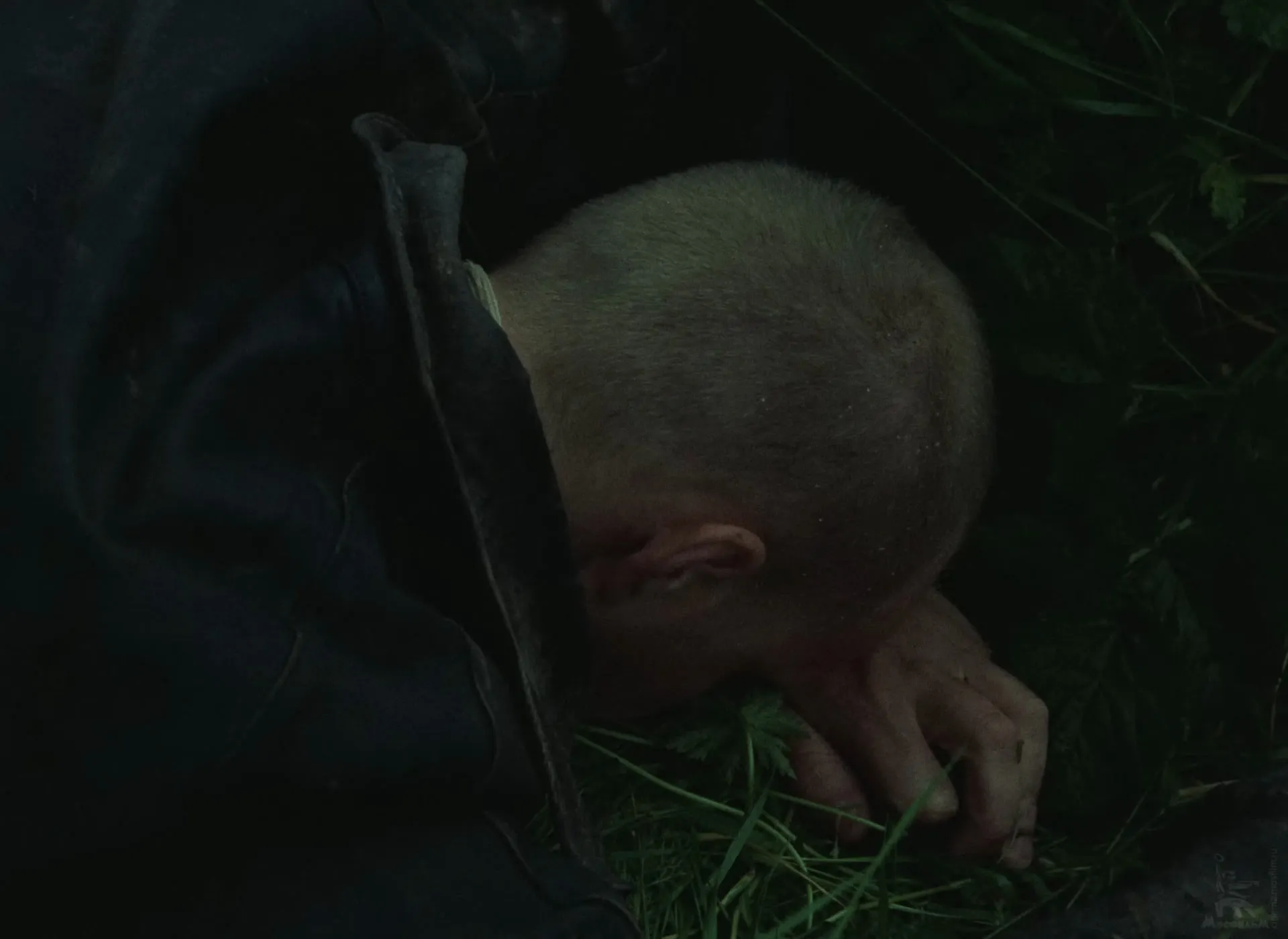 Face down · the Zone
Weakness is great — Lao Tzu, by way of Leskov
At the start of the second part, the Stalker prays without speaking, and we hear his thoughts. Let them believe, let them laugh at their passions, let them become “as helpless as children,” because, in the Russian, weakness is great and strength is nothing. Then the prayer turns into chapter 76 of the Tao Te Ching, the book traditionally credited to the Chinese sage Lao Tzu (Stanford Encyclopedia). James Legge’s 1891 translation gives it plainly: “Man at his birth is supple and weak; at his death, firm and strong,” and so “firmness and strength are the concomitants of death; softness and weakness, the concomitants of life” (Legge).
Tarkovsky didn’t take the lines straight from China. In Russian they are, word for word, the epigraph Nikolai Leskov set at the head of his story “Pamphalon the Entertainer” (1887), signed “Lao-tzy” (Leskov), as two Russian scholars recently noticed (Malyshev and Sheleketa). Leskov’s story is a holy-fool legend. A nobleman of Constantinople gives away his fortune, climbs a rock near Edessa and stands on it, praying, for thirty years. When he asks whether anyone on earth truly pleases God, a voice sends him to Damascus to find Pamphalon, a clown who tumbles in the streets with his dog, and who turns out to have beggared himself to save a woman and her children. The holiest man in the story is a fool. So the Taoist lines reached the Stalker by way of a Russian legend about exactly his kind of saint.
The Bible says the same thing in its own words: “my strength is made perfect in weakness” (2 Corinthians 12:9). The writer Colin Heber-Percy named his book about the film’s faith after that verse, Perfect in Weakness (2019). East and West meet in the Stalker’s prayer the way they meet in Artemyev’s music. And under the prayer the camera watches water, churning in a round shaft and then settling. The Tao Te Ching has a chapter on that too: “There is nothing in the world more soft and weak than water, and yet for attacking things that are firm and strong there is nothing that can take precedence of it” (Legge, chapter 78).
Emmaus and the sixth seal — scripture in the Zone
Two passages of scripture are read aloud in the Zone, and the film is careful where it puts them. While the Stalker sleeps in a shallow channel, a woman’s voice, his wife’s according to Mosfilm’s own audio description of the film, reads from the Book of Revelation. The sixth seal is opened: a great earthquake, the sun “black as sackcloth of hair,” the stars falling “even as a fig tree casteth her untimely figs,” and the great men of the earth hiding in the rocks and begging the mountains to fall on them (Revelation 6:12–17). Meanwhile the camera glides over the bottom of the channel, where the debris of a civilization lies under an inch of water: a syringe, coins, a spring, a clockwork mechanism, part of a gun, a page from a calendar, and a reproduction of John the Baptist from Jan van Eyck’s Ghent Altarpiece (Lorenz). The voice reads the end of the world. The water shows that it has already happened, quietly.
John the Baptist is the right saint to find there. He is the forerunner, “the voice of one crying in the wilderness” (Mark 1:3), who points the way to someone greater and says of him, “He must increase, but I must decrease” (John 3:30). He is a guide who stands aside. The shot ends on the Stalker’s own hand, lying in the water among the things the world threw away.
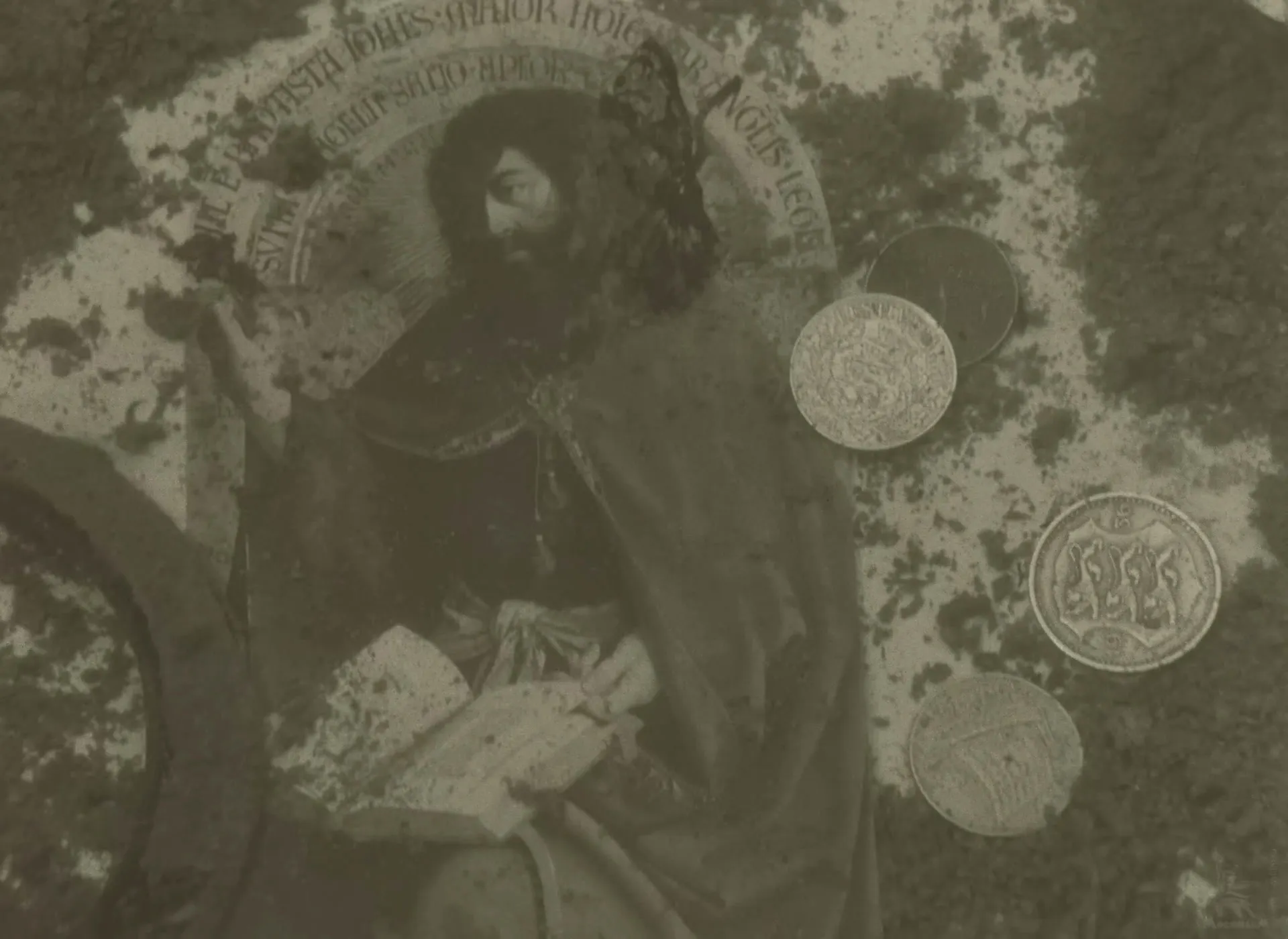 John the Baptist · under water
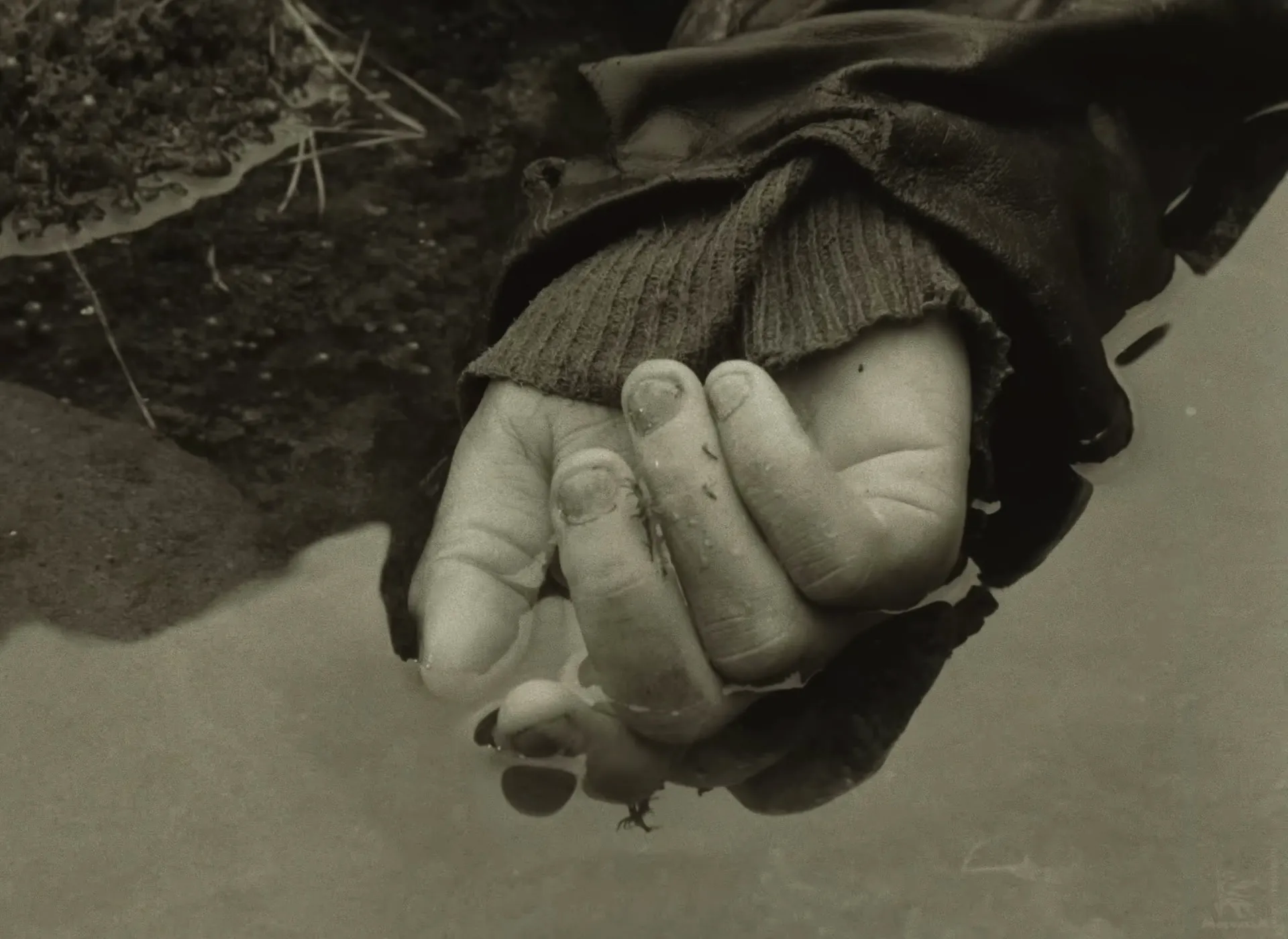 The hand · under water
When the Stalker wakes, he recites from memory the road to Emmaus, from the Gospel of Luke. On the day of the resurrection, two disciples walk to a village, talking sadly, and Jesus himself draws near and walks with them, “But their eyes were holden that they should not know him” (Luke 24:13–16). The Writer and the Professor wake to hear it, and, as the scholar Nariman Skakov notes, they become the two disciples who fail to see (Skakov). Keep the passage in mind for the ending. The miracle of Stalker happens a few feet from people who don’t notice it.
The guide who stays outside — Moses and Virgil
The Stalker never goes into the Room. When the Writer accuses him of enjoying his power too much, he answers that it isn’t allowed: “A stalker is not allowed to enter the Room.” Tarkovsky put it more simply. The Stalker doesn’t go in because “that is not his role” (in interview, 1981).
He belongs to an old line of guides who lead others to a threshold they can’t cross. Moses brings the Israelites through forty years of wilderness, then climbs Mount Nebo to look at the promised land and is told, “I have caused thee to see it with thine eyes, but thou shalt not go over thither” (Deuteronomy 34:4). The reason the Bible gives is a single failure of belief: “Because ye believed me not” (Numbers 20:12). In Dante Alighieri’s Divine Comedy, Virgil leads the poet down through Hell and up the mountain of Purgatory, and at the edge of the earthly paradise he has to stop; he lived before the faith that would let him in. His last words set Dante free: “Free and upright and sound is thy free-will,” he tells him, “Thee o’er thyself I therefore crown and mitre!” (Purgatorio 27, Longfellow’s translation).
The film has its own crowning at its own threshold, and it runs the other way. A few feet from the Room, the Writer sets a wreath of twigs on his head like a crown of thorns, and refuses to go in. Dante is crowned lord of himself. The Writer crowns himself with his suffering. The critic Brad Weismann heard another echo of Dante in the Stalker’s claim that the Zone lets through those who have lost all hope (Senses of Cinema). Over the gate of Dante’s Hell is written, “All hope abandon, ye who enter in!” (Inferno 3). Dante’s gate keeps hope out. Tarkovsky’s Zone lets the hopeless in, and asks them to believe.
Themes, Symbolism, and Philosophical Meaning
The way that is never straight — nuts and bandages
The Stalker’s method looks like superstition, and the Writer says so. The Professor ties strips of white bandage to metal nuts. The Stalker throws one ahead and walks to where it lands. The Room is a stone’s throw away, but “straight paths aren’t the shortest here.” The path that can be walked straight is not the way. Both of the film’s oldest sources say so. Dante’s Comedy opens in a dark wood “For the straightforward pathway had been lost” (Inferno 1), and the Tao Te Ching opens, in Legge’s words, “The Tao that can be trodden is not the enduring and unchanging Tao” (Legge). Tao means the way.
The Zone, the Stalker explains, rearranges its traps the moment people come in, and at every moment it is “just as we’ve made it, we and our state of mind.” Once, the film lets us see the rules bend. In a hall drifted with sand, he throws a nut, and it bounces and drifts down far too slowly while a bird skims the dunes and vanishes in midair. Mosfilm’s own audio description of the film says the nut flies “against the laws of gravity.” The Writer’s cast-iron laws, it seems, don’t hold everywhere.
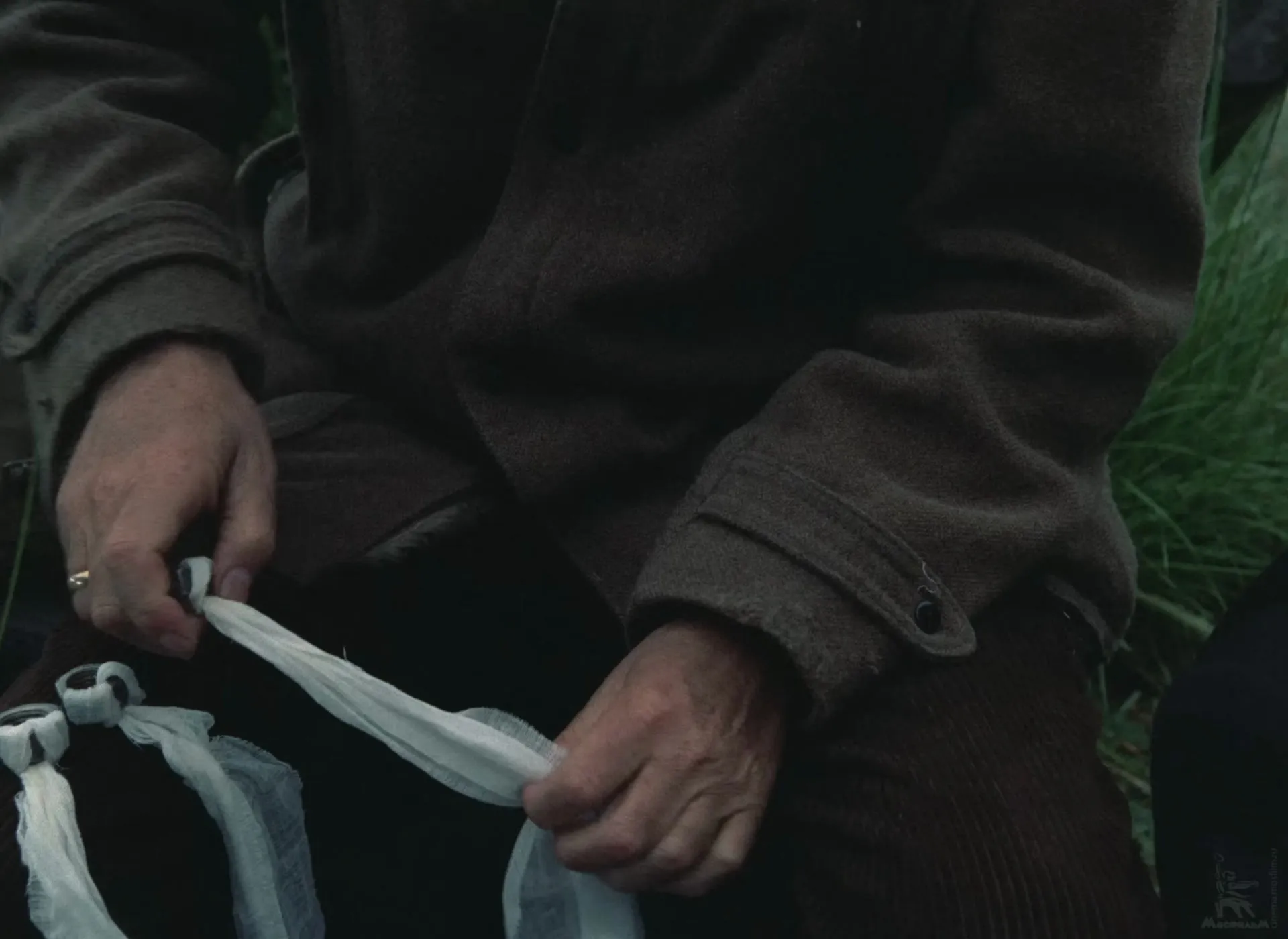 Tied · the ritual
The dog — the Zone comes home
A black dog appears in the Zone from nowhere, while the men rest. It lies down beside the Stalker as he sleeps, follows them all the way out, and at the bar he explains, “It tagged along. We couldn’t possibly leave it.” At home it drinks milk from a bowl on the floor, and the Stalker lies down beside it. It is the only thing anyone brings back from the Zone. The artist Shirin Neshat calls it “a magical presence of love and affection” (Criterion). Leskov’s holy clown, the one whose epigraph the Stalker prays, has a dog too.
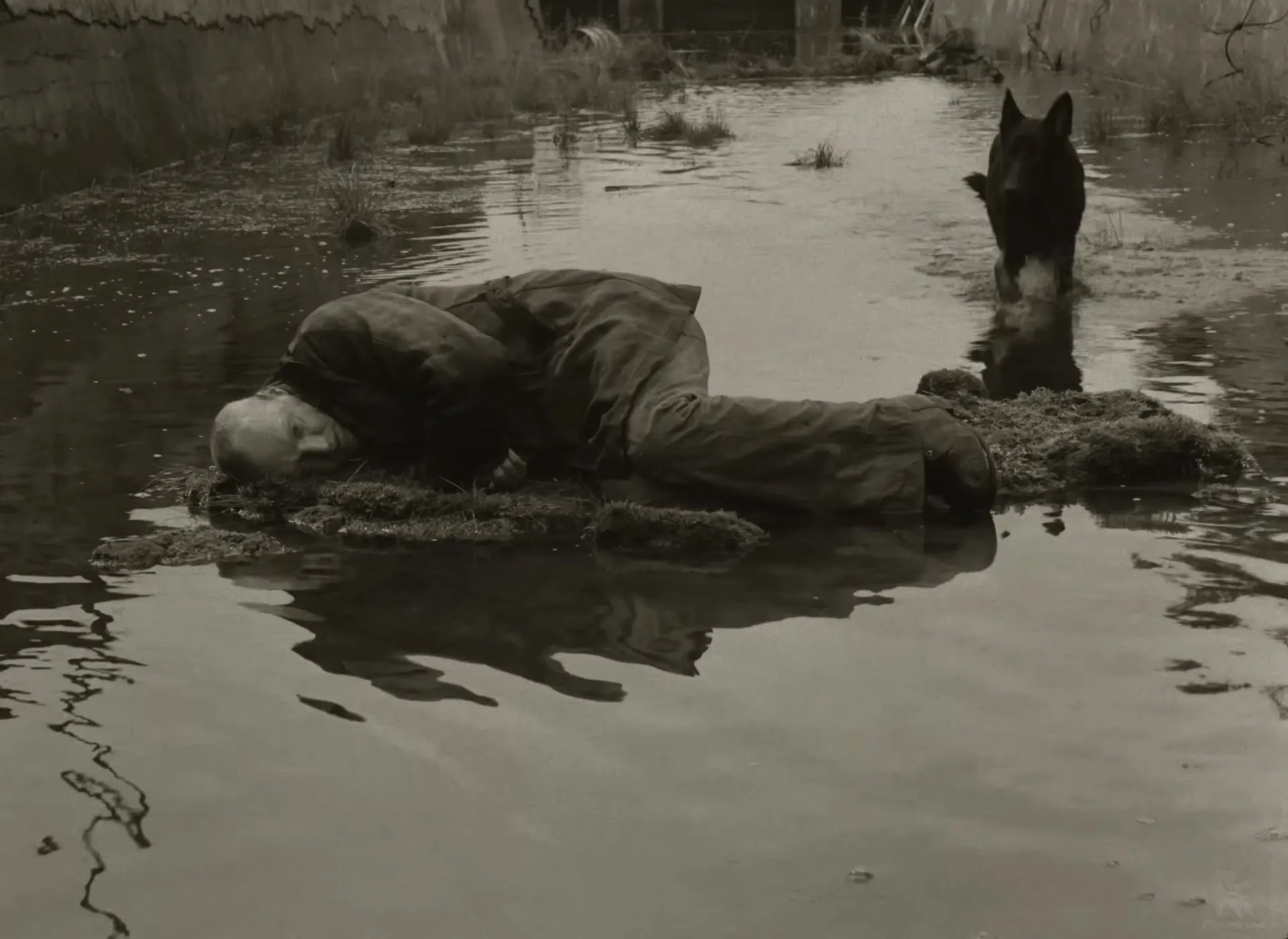 The dog · the Zone
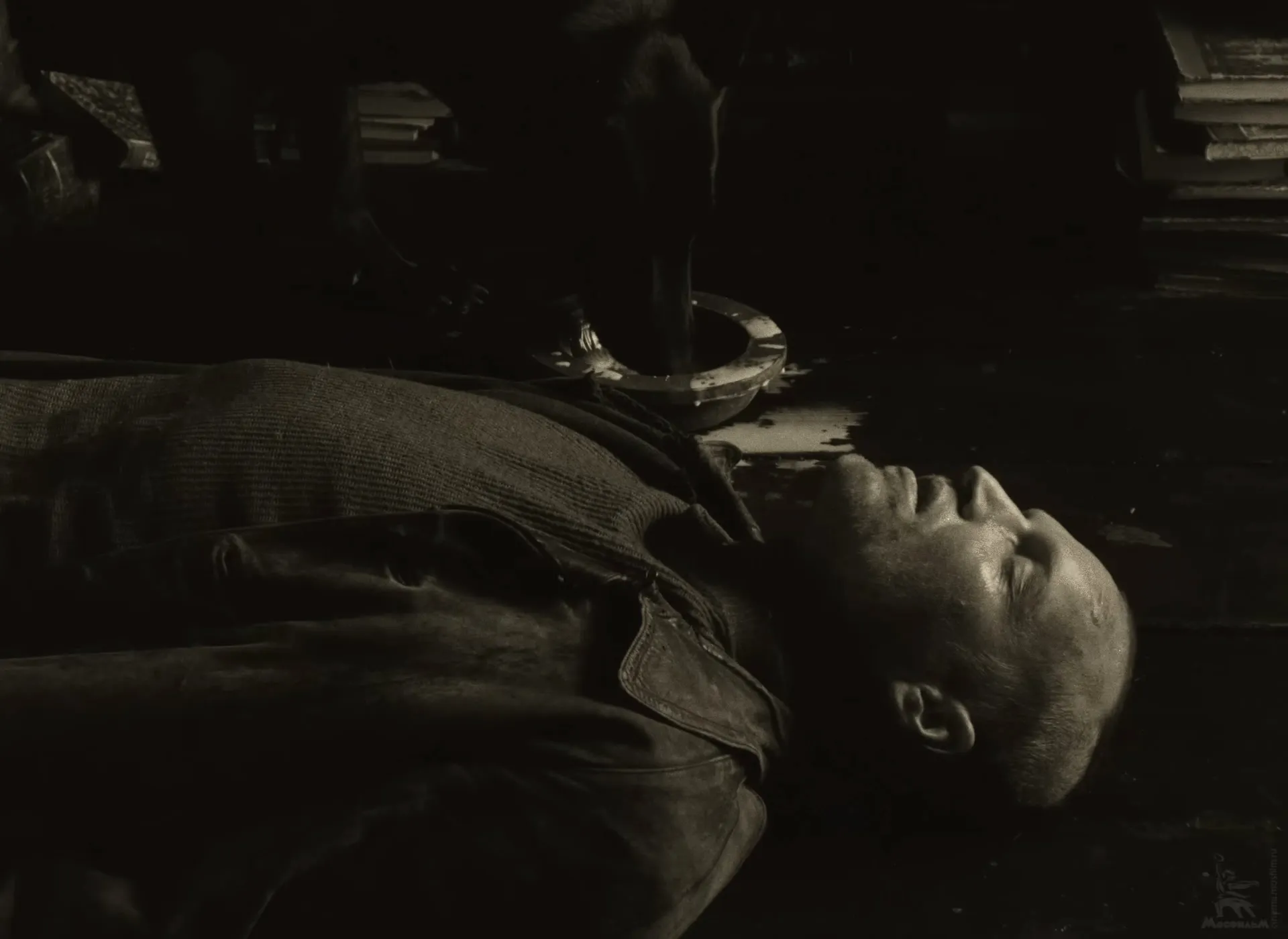 The dog · home
Thorns and lovers — the room before the Room
In the ruined anteroom near the end, two images sit a few feet apart. The Writer has been idly weaving twigs while the Professor talks, and he puts the wreath on his head, like a crown of thorns, at the moment he tells the Stalker, “I won’t forgive you.” And in a corridor behind the dog lie two skeletons in an embrace, under a blanket of dust, with a wedding ring on the woman’s hand and a green shoot growing up through the bones. One man makes himself a martyr out of spite. Two people died holding on to each other. The film sets suffering that refuses beside love that outlasts, and lets us decide which leads into the Room.
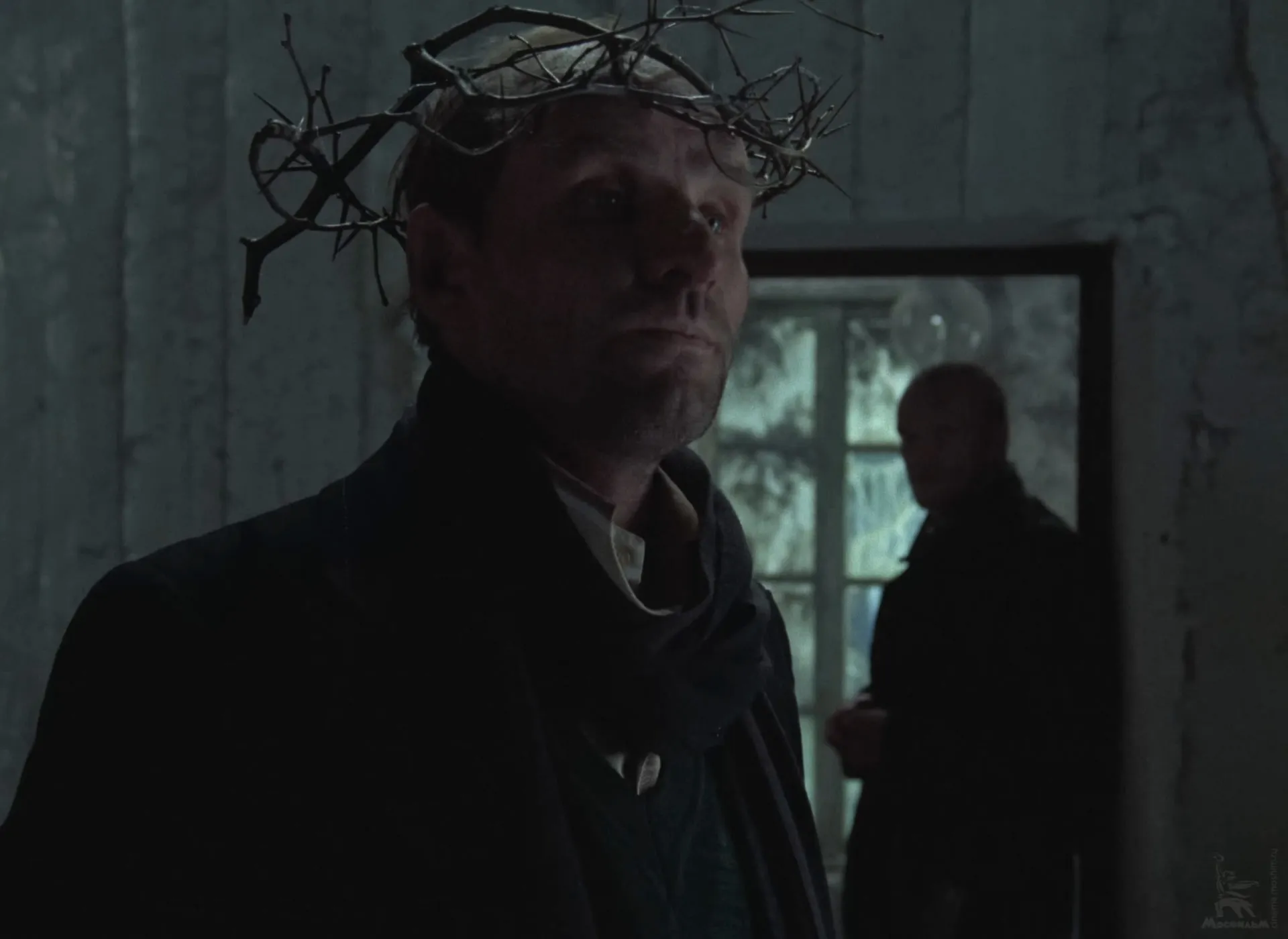 The crown · the Writer
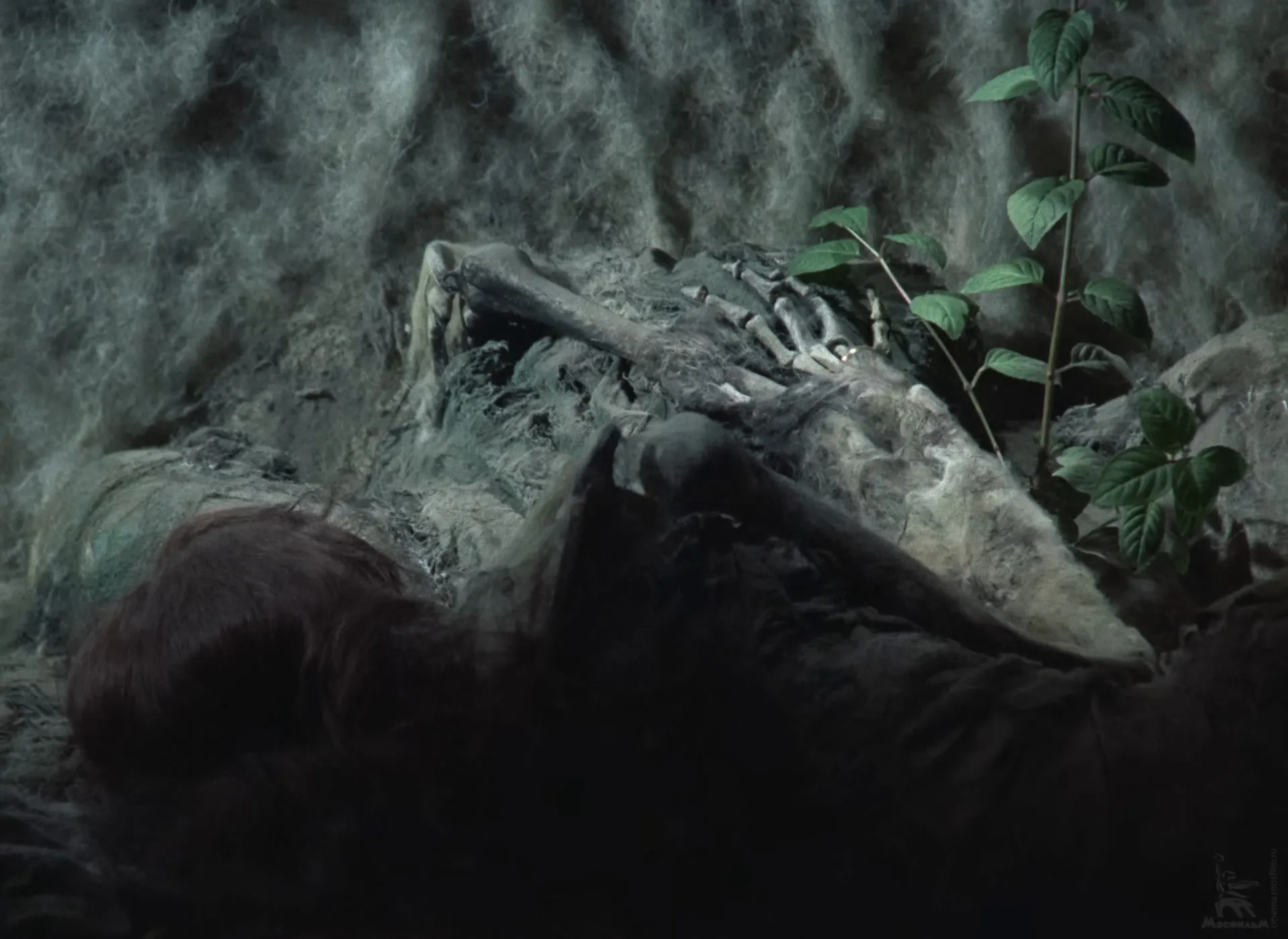 The lovers · the corridor
The threshold — the Room no one enters
The film never shows us the Room with anyone in it. It turns the camera around instead. We see the three men from inside the Room, sitting side by side in its doorway. A light comes up behind us and fades. Then it rains, inside, in front of them. The Professor tosses the parts of his bomb into the water, and the camera finds its dial of numbered buttons on the flooded floor, where a fish noses it while oil spreads across the surface. Nobody goes in. The only things that enter the Room are rain and a bomb taken apart.
Tarkovsky explained the failure in one sentence. “They had summoned the strength to look inside themselves — and had been horrified; but in the end they lack the spiritual courage to believe in themselves.” And yet he refused to call the trip a defeat: “Even though outwardly their journey ends in fiasco, in fact each of the protagonists acquires something of inestimable value: faith” (Sculpting in Time, pp. 198–99). The men walk away from the Room with nothing in their hands. They have seen what they are afraid of, and that, for Tarkovsky, is where faith begins.
The Tao Te Ching has a verse for where they sit. Its first chapter says that to see the mystery we must be without desire, but “if desire always within us be, / Its outer fringe is all that we shall see” (Legge). The men came for their desires, and the outer fringe is as far as they get. And remember who told them what the Room can do. Every story about it, Porcupine’s included, came from the Stalker. The Room is a promise with one witness. Tarkovsky once went further: the Zone doesn’t exist, he said; the Stalker invented it, “so that he would be able to bring there some very unhappy persons and impose on them the idea of hope” (quoted by Žižek).
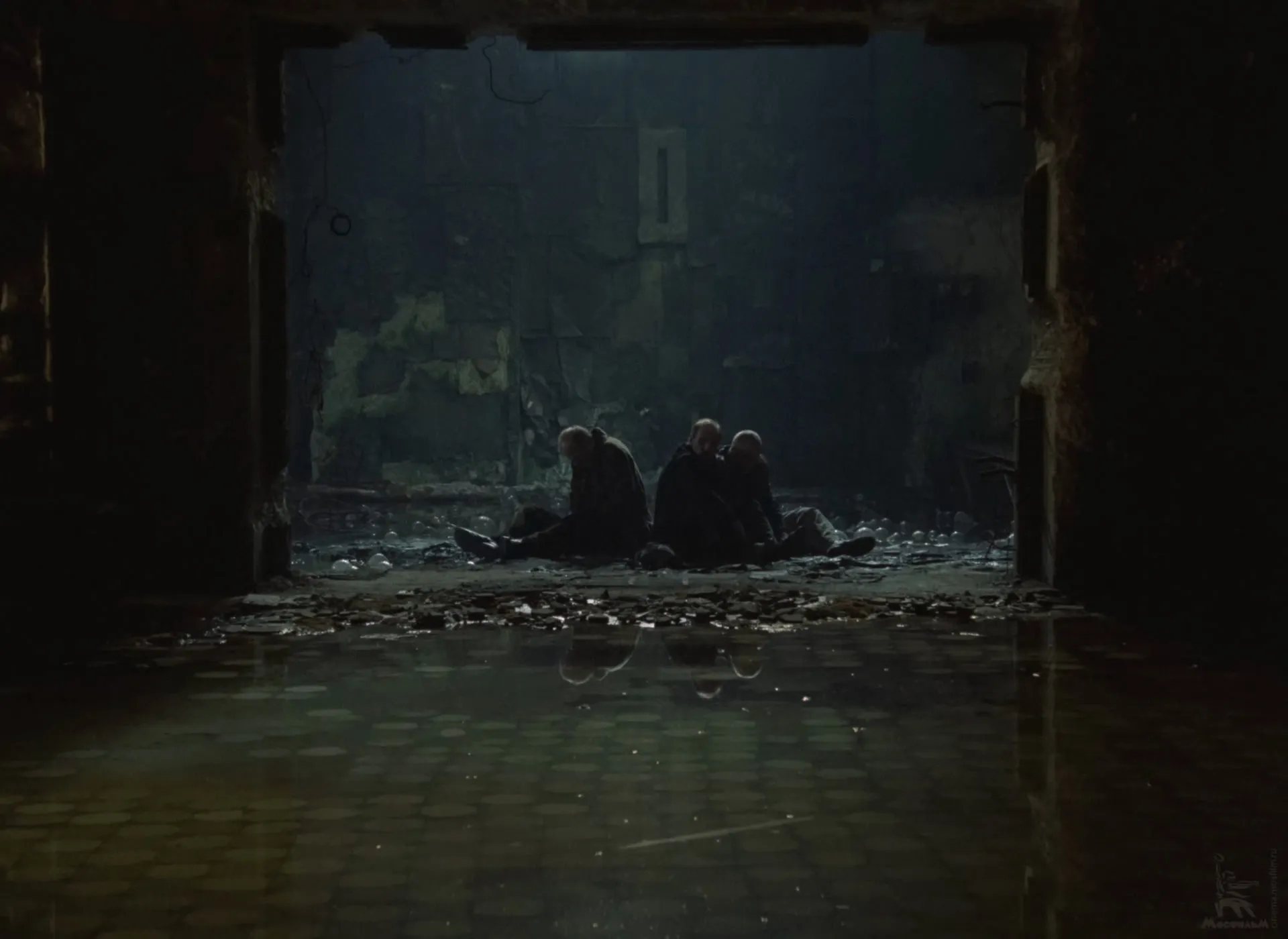 The doorway
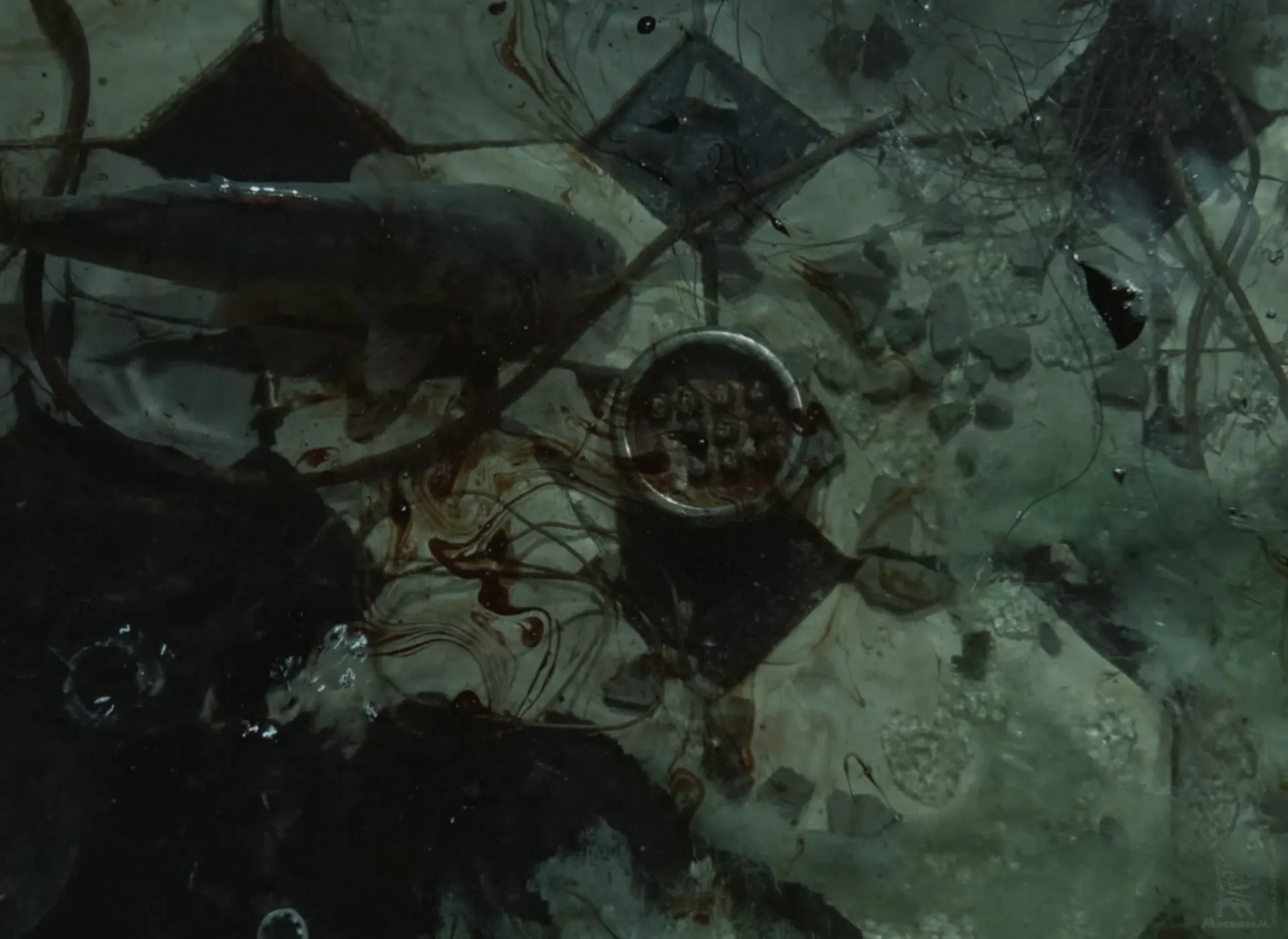 The bomb · under water
Two miracles — the wife’s love and the child’s gaze
The film ends twice. The first ending belongs to the wife. After she has put the Stalker to bed, she sits by the open door with a cigarette and speaks straight into the lens. She knew he was a jailbird and one of God’s fools, she says, and she knew there would be sorrow, but she would rather have “bitter-sweet happiness than a grey, uneventful life.” And if there were no sorrow, it wouldn’t be better. It would be worse, because there would be no happiness either, and no hope.
“Her love and her devotion are that final miracle which can be set against the unbelief, cynicism, moral vacuum poisoning the modern world, of which both the Writer and the Scientist are victims.”Andrei Tarkovsky, Sculpting in Time, p. 198, 1986
That was the plan from the start. Before shooting, Tarkovsky described the Writer’s long tirade about how boring the world of rules is: the Writer “wants to be astonished.” And, he went on, “it is a simple woman who will surprise him, her devotion” (in interview, 1977). His editor, Lyudmila Feiginova, said the whole picture was made around this monologue, and that it was her idea to move it to the end and address it to everyone watching (Feiginova). Tarkovsky called it his favorite scene (in interview, 1980).
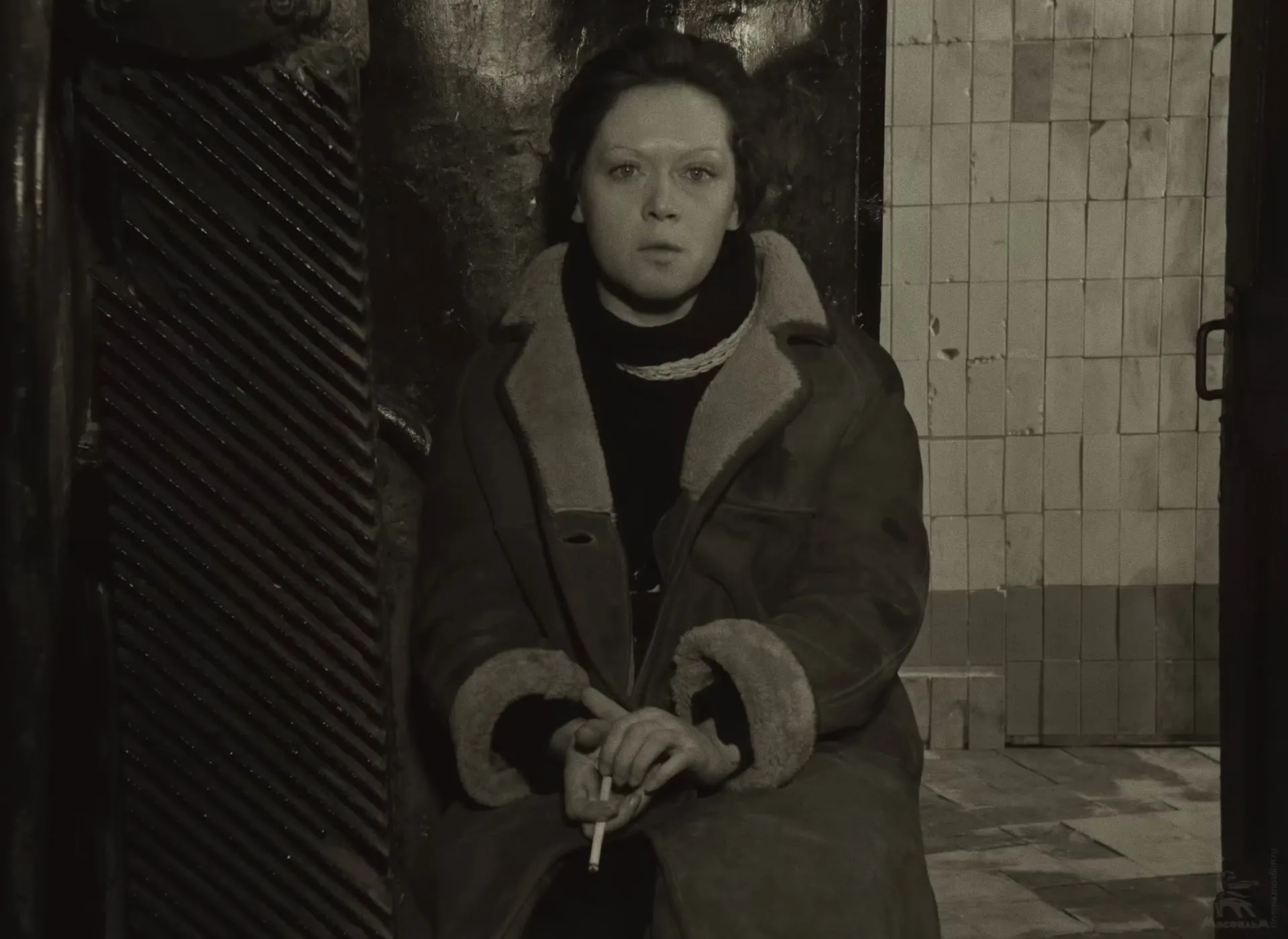 The wife · to us
Notice what she offers, a moment before. She asks if he wants her to go to the Zone with him. Doesn’t he think she has something to ask for? He says no. “What if you fail, too?” Earlier versions of the story let the stalker hope the wish-granting place could heal his daughter (Johnson and Petrie). Tarkovsky’s film never lets anyone ask. The scholar R. B. Lemberg Perelmutter argues that the film “entirely rejects the idea of a cure” (Disability Studies Quarterly). Monkey is not healed. Something else happens to her.
The second miracle came late. Sharun remembered a film he had seen of a Soviet woman, Ninel Kulagina, who claimed to move objects with her gaze, and Tarkovsky saying afterward, “here is the ending for Stalker!” The glass was pulled across the table on an invisible thread, and Tarkovsky pulled it himself (Sharun). Critics tend to crown one ending or the other. The film needs both. The wife answers the Writer’s despair. The glass answers his cast-iron laws.
The ending — two glasses
In the first minutes of the film, a train approaches the Stalker’s house, and a glass of water on a chair beside the bed begins to shiver and slide. In the last minutes, Monkey, who has been reading by the window, sits at the kitchen table, in color, and looks at a glass of tea. It slides across the table. So does a jar, and then a tall empty glass, which falls to the floor. Tarkovsky said it doesn’t break (to Tonino Guerra, 1979). Only then does a train come, shaking the room.
Critics noticed the rhyme long ago. The Japanese novelist Kenzaburō Ōe wrote a chapter about a family arguing over whether the train moves the glasses (A Quiet Life), and Vida Johnson and Graham Petrie point out that the train is heard only after the child has moved them, so it can hardly have caused it (Johnson and Petrie, p. 150).
Those two images are the film’s argument. In the first, a train moves the glass: the world of cast-iron laws, matter pushing matter. In the last, a child moves it: something the laws don’t cover. Same house, same railway, same small slide across a surface. Only the cause has changed.
The poem Monkey has just been reading is Tyutchev’s “I love your eyes, my friend” (1836), about the lightning in a lover’s sudden glance. Its last word, in Russian, is zhelanya: desire (Tyutchev). It’s the word the whole film turns on. The Room was supposed to grant desire. The Writer was afraid of his. And at the end a girl who can’t walk, with a love poem in her head, moves the world with her eyes. Then the train comes, and through its roar, the “Ode to Joy.”
Existential and Analytical Interpretation
The analytical core — what the Room knows
The Room’s rule is simple, and it is terrifying. It doesn’t grant what you ask for. It grants what you are. That is the Writer’s theory, and the film gives it to the most intelligent man in it. Porcupine went in to beg for his brother, the Writer argues, and came out with money, because the Room gives you “the essence of your nature,” the desire that governs you without your knowing it. Seeing it, Porcupine hanged himself.
Desire, in this film, never reaches a stopping place. After the meat grinder the Stalker recites a poem he says Porcupine’s brother wrote. The opening credits tell us whose it really is: the director’s father, Arseny Tarkovsky. Every stanza counts a blessing, the warm sun, a lucky life that has sheltered him, and every one ends the same way: “but it isn’t enough.” It is the most exact description of desire in the film, and Tarkovsky gives it to a man who was killed by someone else’s.
On the Writer’s theory, the Room is a machine for self-knowledge with no appeal. Entering it means being shown who you are, with no chance to argue. The men’s problem isn’t the Zone’s traps. It is the Writer’s question in the shed: how am I to know what I really want? Nobody can know in advance, so nobody can know whether they would survive the answer. And no one can prove the Room works at all. “Who told you?” the Writer asks, and the Professor nods at the Stalker. The men are asked to stake everything on a promise with one witness. That is the situation of faith, and existentialism is the philosophy that took it most seriously.
Kierkegaard — despair, and the leap no one takes
Kierkegaard sketched three ways of living, the aesthetic, the ethical and the religious, and gave each a voice in his books (Stanford Encyclopedia). The aesthete lives for “the interesting,” and his great enemy is boredom; one of Kierkegaard’s aesthetes sets himself the task of avoiding boredom at all costs, and drifts into despair. The Writer is that man. His first speech is about how boring the world is, and he ends it with a joke Kierkegaard would have enjoyed: don’t hope for flying saucers, “It would be too interesting.” The Professor, who carries a bomb across the Zone out of duty to everyone else and agonizes over the principle that one should never do anything irreversible, is the man of ethics. The Stalker is the third way, and it is the only one that goes through the Zone on its knees.
Kierkegaard’s name for the Writer’s condition is despair, which he meant not as a mood but as the failure to become a self. One form he called the despair of necessity: the fatalist who, having lost hope, can see no possibilities left (Stanford Encyclopedia). That is a world of cast-iron laws. “Only one man interests me, namely, myself,” the Writer says in the Zone. “Am I worth anything, or am I shit, like certain other people?” He longs to know, and he won’t let the Room tell him. Tarkovsky said the Writer is afraid to go in “because his opinion about himself is rather unflattering” (in interview, 1981).
Kierkegaard also gave anxiety its image. Anxiety, he wrote in The Concept of Anxiety (1844), is “the dizziness of freedom”: the self looks down into its own possibility, the way an eye looks down into a yawning abyss, and reels (Stanford Encyclopedia). Before his long speech of self-disgust, the Writer stands at a deep metal well, drops a stone into it and waits a long time for the sound.
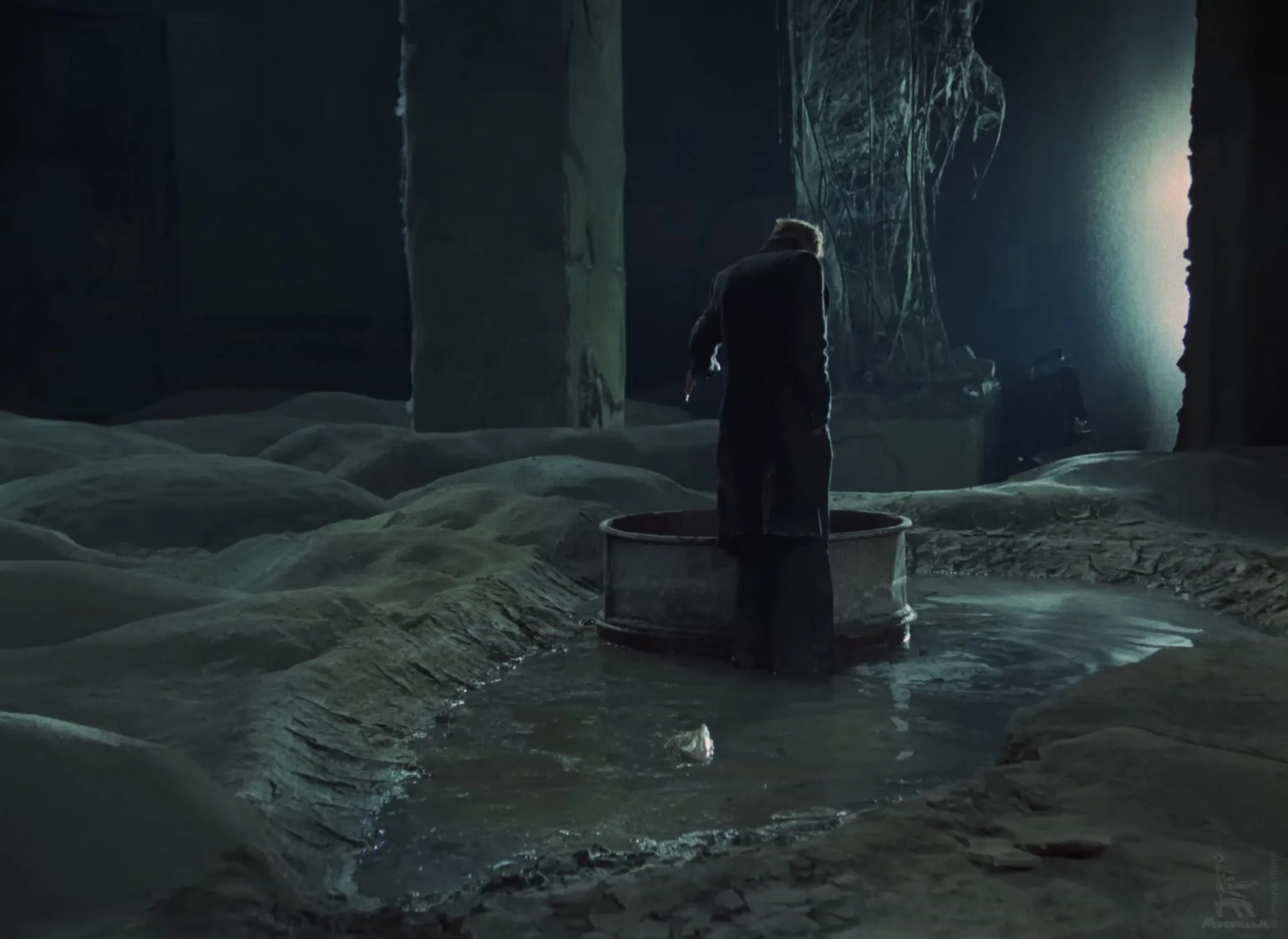 The well
The Stalker is the other half of Kierkegaard. Faith, for Kierkegaard, is not a belief you arrive at by argument but a passion, a whole life staked on something that can’t be proved. The Stalker has the passion without the proof, and he can’t hand it to anyone else. (The critic Stephen Borunda has read him as Kierkegaard’s lover of others, set against a Nietzschean Writer and Professor (Film Inquiry).) Tarkovsky’s collaborator Olga Surkova recorded him describing the film in 1978 as “the tragedy of a man who wants to believe, who wants to make himself and others believe in something,” and as being, in the end, “about the victory of materialism” (our translation; Surkova’s diary). Johannes de silentio could describe the leap and not make it. The Stalker can make it, and can’t make anyone follow.
Dostoevsky — the stone wall and the Grand Inquisitor
The Writer’s speech outside the bar is pure Dostoevsky, turned inside out. In Notes from Underground (1864), the Underground Man rages against what he calls the stone wall. “What stone wall? Why, of course, the laws of nature, the deductions of natural science, mathematics.” He dislikes the fact that twice two makes four, and he can’t break through the wall, he admits, “but I am not going to be reconciled to it simply because it is a stone wall and I have not the strength” (Garnett’s translation). The Writer believes in the wall completely. The world is ruled by cast-iron laws that can’t be broken, and that is exactly what bores him. He has the Underground Man’s despair without his revolt.
The Professor brings in Dostoevsky’s most famous parable by name. In The Brothers Karamazov (1880), Ivan tells the story of a Grand Inquisitor who arrests Christ when he returns to Seville. People can’t bear freedom, the Inquisitor argues; they want bread, and someone to obey, and the church has given it to them by taking freedom away. “There are three powers, three powers alone, able to conquer and to hold captive for ever the conscience of these impotent rebels for their happiness—those forces are miracle, mystery and authority” (Garnett’s translation). In the Zone the Professor fears the Room will draw “would-be emperors, grand inquisitors, fuhrers of all shades.” Then the Writer turns the charge on the Stalker: he revels in “power, mystery, authority.” It is the Inquisitor’s triad with one word changed. The film refuses the Inquisitor the first of his three powers. It withholds the miracle all the way to the threshold, and then it gives a small one to a child, at home, where no one is watching. Tarkovsky later imagined a sequel in which the Stalker, despairing of anyone believing, starts dragging people into the Zone by force to make their lives better, and turns into a fascist: “This is already the idea of the Grand Inquisitor” (in interview, 1985).
Shestov — Athens against Jerusalem
Lev Shestov, a Russian philosopher who died in Paris in 1938, called one of his early books All Things Are Possible (1905), and spent the rest of his life arguing with “self-evident truths,” the laws of reason and necessity that philosophy treats as unbreakable. In his last book, Athens and Jerusalem, Athens stands for reason and Jerusalem for faith, for which, as he learned from Kierkegaard, nothing is impossible (Lev Shestov). His book on Kierkegaard (1936) is subtitled Vox clamantis in deserto, the voice of one crying in the wilderness: John the Baptist’s words, and John is the saint lying under the water in the Stalker’s dream. It is the Gospel’s promise, “with God all things are possible” (Mark 10:27). Real thinking, Shestov held, begins only when reason has run out of possibilities and “we run up against the wall of impossibility.” It is Dostoevsky’s stone wall again. The Writer lives in Athens, and finds it unbearably boring. The Stalker is Jerusalem’s last citizen, and nobody believes him. The glass that slides across the table at the end is Jerusalem’s reply. It doesn’t refute the cast-iron laws. It shows they aren’t the whole story.
Camus — the case against hope
Albert Camus read Kierkegaard and Shestov closely, and refused them. In The Myth of Sisyphus (1942) he describes the absurd: the clash between our longing for meaning and the world’s unreasonable silence. He admires how honestly Kierkegaard and Shestov faced it, and then accuses them of escaping it. Their leap into faith, he says, is “philosophical suicide,” a way of trading the absurd for hope (The Myth of Sisyphus). The honest response, for Camus, is to live without consolation, lucid, and to find a kind of happiness in the struggle itself: “One must imagine Sisyphus happy” (Stanford Encyclopedia).
Stalker stages that argument. The Writer is Camus’s lucid man: no ghosts, no God, no flying saucers, and no leap. At the threshold he refuses to pray because it is shameful to humiliate yourself, “to snivel and to pray.” But he isn’t Sisyphus. He is drunk and bored, and he wants, as Tarkovsky said, to be astonished. The Stalker is the leap Camus refused, and he can’t make it work for anyone. The critic Gilbert Adair, reviewing the film in 1980, called the Stalker’s life “the Sisyphian task of sustaining a doubtful faith” (Sight & Sound). At the threshold the film leaves the argument unsettled. Then, at home, it lets the wife settle it in her own words. Camus asked for lucidity without hope. She has lucidity and hope together: she knew exactly what she was choosing, and she says that without the sorrow “there’d be no hope.” Tarkovsky’s own quarrel with Camus was over the last word of The Myth of Sisyphus. “Man doesn’t live in order to be happy,” he told an audience in London in 1984. “There are things far more important than happiness” (our translation; Tarkovsky).
Sartre — what we make of ourselves
The Writer’s theory of the Room rests on something existentialism denies. He imagines a fixed essence hidden in each of us, a true nature the Room will dig up whether we like it or not. Jean-Paul Sartre argued the opposite. For human beings, existence precedes essence: we turn up in the world first, and only afterward become something, through what we choose. Pretending we are fixed things, with natures that excuse us, is what he called bad faith (Stanford Encyclopedia).
The Stalker’s own account of the Zone is closer to Sartre than the Writer’s theory is. The Zone, he says, is at every moment “just as we’ve made it, we and our state of mind.” If he is right, Porcupine wasn’t condemned by a hidden nature. He made his choice in the meat grinder, when he sent his brother through instead of himself. The Writer would rather believe in a shameful essence he can’t change than risk the freedom to become something else. That is his bad faith, and it keeps him on the threshold.
The argument
Laid out as an argument, the film runs like this.
Premise 1: The Room grants not what you ask for but what you are.
Premise 2: No one can know in advance what they are, or prove that the Room works.
Conclusion: To enter the Room is to leap: to stake yourself on a promise you can’t verify.
Premise 3: The men won’t leap, and the Stalker may not.
Therefore: If a miracle comes, it can’t come from the Room. It comes as a gift, to someone who never asked: in the wife’s love, and the child’s gaze.
Kierkegaard would recognize the shape. The leap comes first, and the gift is never earned. The wife made her leap years ago, when the Stalker said “Come with me” and she went.
Conclusion — the walk home
Johannes de silentio couldn’t make the leap himself, but he knew what the man who could would look like. The knight of faith, he said, “looks just like a tax collector,” someone you could pass in the street without a second glance (Notre Dame Philosophical Reviews). Nothing about him shows that he has staked everything. And Abraham didn’t stay on the mountain. He went home.
Stalker ends the same way. The men who went looking for a miracle sat down at the threshold and got rain. The Stalker came home and despaired. The knight of faith was at home the whole time: a woman by an open door with a cigarette, who went when she was asked and never regretted it. And the miracle happened to a child at a kitchen table, with no one watching but us, and a dog. Abraham got his son back “by virtue of the absurd.” The Stalker’s daughter moves a glass with her eyes. Neither story explains how. Both end with a parent, a child and a walk home.
The Writer wanted to be astonished. He went to the wrong room.
“Because then there’d be no happiness, either. And there’d be no hope.”